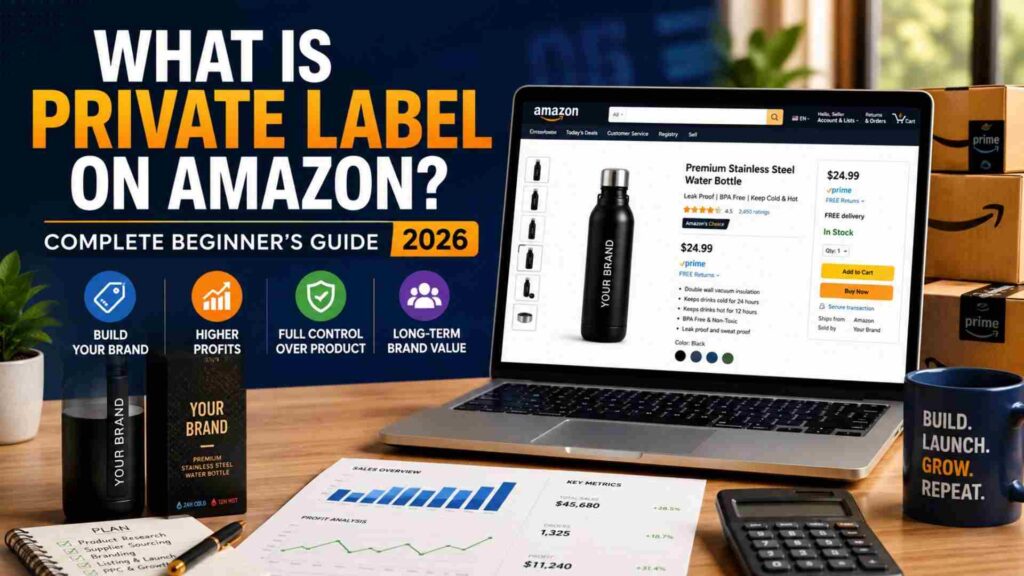
Selling on Amazon has changed a lot over the past decade. Reselling other people’s products used to be enough to make money; now the sellers pulling ahead are the ones building their own brands. That’s where Amazon private label services come in.
If you’ve researched how to start selling on Amazon, you’ve probably run into the term “private label” more than once. It’s become the go-to model for sellers who want more than a short-term hustle; they want an asset they actually own.
This guide walks through what Amazon private label is, how the model works from start to finish, why so many sellers choose it over other business models, and what it realistically costs and takes to succeed. By the end, you’ll have a clear roadmap for evaluating whether private label is the right move for you.
What Is Amazon Private Label?
Private label means you find an existing, generic product, have it manufactured under your own brand name, and sell it as a unique offering even though similar versions exist elsewhere.
In practice, that looks like this: a supplier already makes a bamboo cutting board. You order that same board, but with your logo on the packaging, your own product tweaks, and your own listing. The manufacturer isn’t exclusive to you, but the branding, packaging, and customer experience are entirely yours.
This differs from manufacturing a product from scratch. You’re not inventing something new; you’re taking a proven product, improving on it, and putting your name behind it.
Ready to turn your product idea into a real Amazon brand? Our Amazon Private Label Services can help you from product research to launch and growth.
Who should consider private label?
It suits sellers who want to build long-term brand equity rather than chase short-term arbitrage flips, who are comfortable investing capital upfront, and who are willing to put in the research work before ordering inventory. It’s less suited to sellers looking for a fast, low-capital side hustle.
Amazon Private Label Services
Help sellers move beyond simple reselling and build a brand they actually own. Instead of creating a new product from scratch, you source an existing, proven product and sell it under your own name, packaging, and branding. This gives you more control over pricing, quality, and customer experience, which is why more sellers are choosing private label over wholesale, dropshipping, or arbitrage.
How Does Amazon Private Label Work?
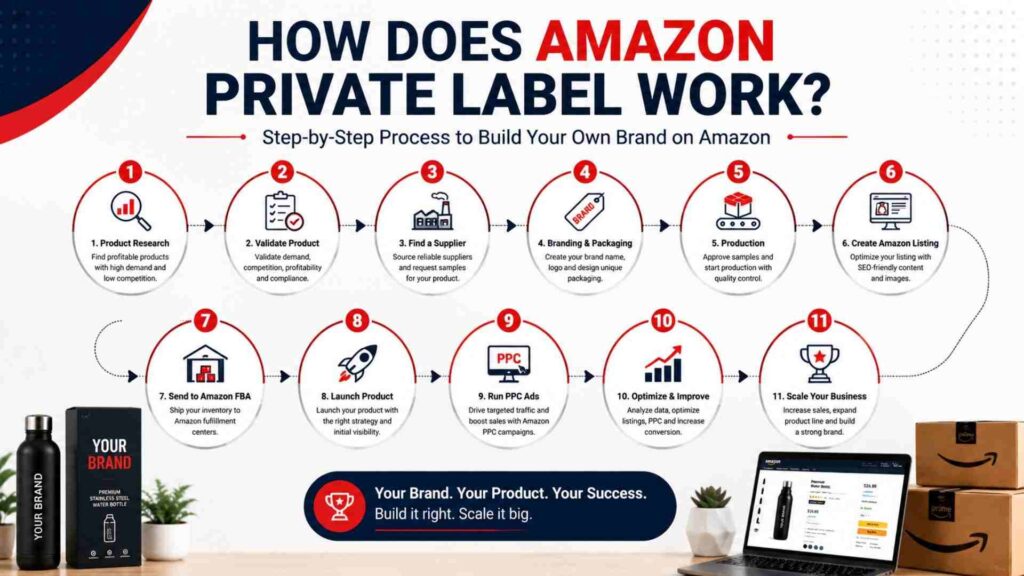
Every private label business moves through the same core stages, even if the timeline and details vary by product:
- Product Research: Identify categories and products with strong demand and manageable competition.
- Validation: Confirm the opportunity is real using sales data, reviews, and demand signals.
- Sourcing: Find and vet manufacturers who can produce the product to spec.
- Branding: Develop your brand name, logo, and packaging design.
- Production: Order samples, then place a full production run.
- Listing Creation: Write optimized titles, bullets, descriptions, and upload images.
- FBA Setup: Ship inventory into Amazon’s fulfillment network.
- Launch: Drive initial sales and reviews to build listing momentum.
- PPC Advertising: Run paid ads to generate visibility and ranking.
- Optimization & Scaling: Refine the listing, pricing, and ad campaigns, then expand the product line.
If you’re wondering how to sell private label products on Amazon, the process starts with product research and validation, followed by sourcing, branding, listing creation, inventory management, launch, and ongoing optimization.
Why Start an Amazon Private Label Business?
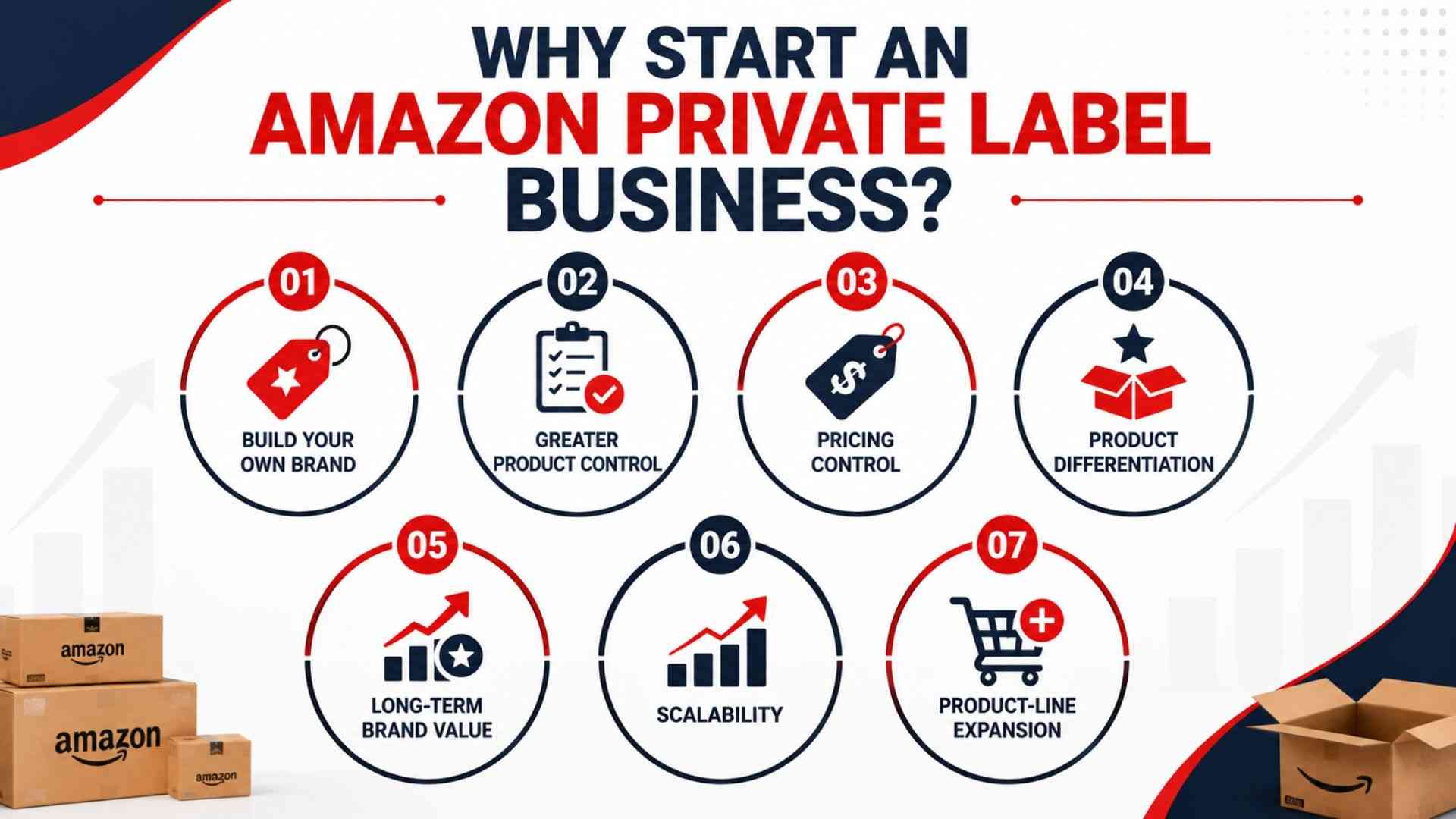
Amazon Private label offers several advantages compared with simply reselling existing products.
Build Your Own Brand
You control the brand identity, packaging, positioning, and customer experience.
Greater Product Control
You can work with suppliers to improve materials, features, packaging, or functionality.
Pricing Control
Owning the brand gives you more flexibility in developing a pricing strategy.
Product Differentiation
Instead of selling the same product as everyone else, you can create meaningful improvements.
Long-Term Brand Value
A successful private label business can become more than an Amazon listing. It can develop into a recognizable brand with multiple products.
Scalability
Once you have a successful product and repeatable systems, you can expand into complementary products, variations, bundles, and additional marketplaces.
Amazon Private Label vs. Other Business Models
| Factor | Private Label | Wholesale | Retail/Online Arbitrage | Dropshipping |
|---|---|---|---|---|
| Investment | Medium–High | Medium | Low–Medium | Low |
| Brand ownership | Full | None | None | None |
| Control | High | Low | Low | Low |
| Competition | Lower (unique listing) | High (shared listing) | High | Very high |
| Margins | Higher | Lower | Variable | Lowest |
| Scalability | High | Medium | Low | Medium |
| Risk | Upfront capital risk | Supplier dependency | Sourcing inconsistency | Quality/shipping risk |
Private label generally requires more capital and patience upfront, but it’s the only model on this list where you’re building an asset you actually own.
How to Find and Validate a Profitable Amazon Private Label Product

Finding a promising Amazon private label product is only the first step. Before investing in inventory, you need to validate whether the product has consistent demand, manageable competition, healthy margins, and a realistic opportunity for differentiation.
1. Evaluate Product Demand
Look for products with steady search volume and consistent sales, rather than products experiencing a temporary seasonal spike.
Use multiple data sources and research tools to confirm that demand is genuine and sustainable.
Ask:
- Is search demand consistent?
- Are multiple sellers generating sales?
- Is the product dependent on a short seasonal period?
- Does demand appear stable across different data sources?
2. Analyze Competition
Assess how many strong competitors already dominate the first page of Amazon search results.
Look at:
- Number of competing listings
- Competitor review counts
- Product ratings
- Pricing
- Listing quality
- Product features
- Brand strength
A competitive market is not automatically a bad opportunity, but you should be able to identify a realistic way to compete.
3. Study Competitor Reviews
Competitor reviews can reveal what customers actually like and dislike about a product.
Pay particular attention to recurring complaints about:
- Product quality
- Missing features
- Durability
- Packaging
- Size or design
- Instructions
- Customer experience
These complaints can become opportunities to improve a private-label product.
4. Check the Price and Profit Margin
Make sure the selling price leaves enough room for a healthy margin after accounting for all major costs.
Calculate:
- Product cost
- Freight and shipping
- Amazon fees
- Storage
- PPC
- Returns
- Packaging
- Other operating costs
A product with strong sales potential is not necessarily profitable if its costs are too high.
5. Identify Product Differentiation Opportunities
Before moving forward, ask:
Can you genuinely make this product better, or would you simply be another copy?
Look for opportunities to improve:
- Product features
- Materials
- Design
- Packaging
- Instructions
- Customer experience
- Product bundles
Your differentiation should solve a real customer problem rather than being a superficial change.
6. Check Seasonality
Determine whether demand remains relatively consistent throughout the year.
A product that looks highly profitable during a seasonal peak may perform very differently during the rest of the year.
Consider:
- Seasonal demand patterns
- Historical sales trends
- Holiday-related demand
- Off-season performance
7. Evaluate Size, Weight, and Shipping
Product dimensions and weight can significantly affect your costs.
Before ordering inventory, consider:
- Freight costs
- Amazon fulfillment fees
- Storage costs
- Product fragility
- Packaging requirements
- Shipping complexity
Smaller and lighter products may offer logistical advantages, although profitability should always be evaluated based on the complete cost structure.
8. Check Amazon Restrictions and Compliance
Before committing to a product, verify whether it falls into a restricted category or requires specific documentation, certifications, or safety requirements.
Check for:
- Amazon category restrictions
- Product-specific requirements
- Safety requirements
- Required certifications
- Shipping or handling restrictions
Do this before ordering inventory, not after.
9. Use the Proceed / Investigate / Reject Framework
After completing your research, classify the product into one of three categories.
Proceed:
Demand is healthy, competition is manageable, margins are strong, differentiation is realistic, and sourcing and compliance look manageable.
Investigate:
Important information is still unclear, such as demand consistency, supplier reliability, actual profitability, or compliance requirements.
Reject:
The product has poor economics, overwhelming competition, weak differentiation, unreliable sourcing, or significant compliance concerns.
This Proceed / Investigate / Reject approach can help you avoid committing money to inventory before the opportunity has been properly validated.
What Does Amazon Private Label Cost?
There’s no single number here; costs scale with product type and order size. Budget for:
- Samples and product inspection
- Initial inventory (often the largest expense)
- Branding, logo, and packaging design
- Trademark registration
- Freight and shipping
- Amazon referral and fulfillment fees
- Product photography
- Launch-phase PPC spend
- Working capital to cover reorders before the first batch even sells out
Rough scenarios: a small, simple product might launch for $2,000–$5,000. A mid-complexity product with better packaging and a larger order often runs $5,000–$15,000. More complex or premium products can easily exceed $20,000. Treat these as starting points, not guarantees; get real supplier quotes before committing.
How to Find and Verify a Private Label Supplier
Most sellers find suppliers through manufacturer directories, sourcing agents, or in-person trade shows. When comparing suppliers, evaluate:
- Minimum order quantity (MOQ) and whether it fits your budget.
- Pricing at different order volumes.
- Production capacity and typical lead times.
- Certifications relevant to your product category.
- Payment terms (deposit vs. balance, accepted methods).
- Shipping terms (FOB, EXW, etc.).
Before committing, verify the supplier is legitimate: confirm business registration, request factory audit reports or photos, order paid samples, understand their quality-control process, check for relevant certifications, and ask for references from other clients. Use secure payment methods that offer some protection, and watch for red flags like refusal to provide samples, unusually low prices, or pressure to pay the full balance upfront.
Ordering and Inspecting Production
Once you’ve chosen a supplier, approve samples, finalize written specifications (materials, dimensions, colors, and packaging), place the production order, and arrange a third-party quality inspection before shipment, checking both the product itself and the packaging. Only after inspection passes should you proceed with shipping preparation.
How to Differentiate Your Private Label Product
This is where many private label businesses win or lose. Differentiation means giving customers a real reason to choose your product over the ten similar-looking listings already on page one. Start by analyzing competitor weaknesses and reading their negative reviews closely; patterns in complaints point directly to opportunities. From there, look for ways to improve product features, upgrade materials, redesign packaging, offer smart bundles, write clearer instructions, and generally improve the end-to-end customer experience. The goal is a genuine, defensible value proposition, not just a different logo on the same generic product.
How to Build Your Private Label Brand

A Private label business becomes much stronger when the product is connected to a recognizable brand.
Important branding elements include:
Brand Name
Choose a memorable name that fits your category and long-term plans.
Logo
Create a professional visual identity that works across packaging and digital assets.
Packaging
Packaging should communicate your brand while protecting the product.
Brand Positioning
Decide what your brand stands for and who it serves.
Brand Story
A clear brand story can help create a stronger connection with customers.
Visual Identity
Keep colors, typography, photography, packaging, and other visual elements consistent.
Amazon Brand Registry for Private Label Sellers
Brand Registry is Amazon’s program for sellers with a registered trademark, giving access to enhanced brand protection and marketing tools. To qualify, you generally need an active trademark registration (or pending application in some marketplaces) matching your brand name and logo.
Benefits include:
- Stronger brand protection against counterfeiters and listing hijackers
- A+ Content for richer, more visual product descriptions
- A dedicated brand store
- Access to Sponsored Brands advertising
- Brand Analytics for deeper customer insights
A common mistake is delaying trademark filing until after launch since trademark approval can take months, starting the process early avoids missing out on these benefits during your most important early sales period.
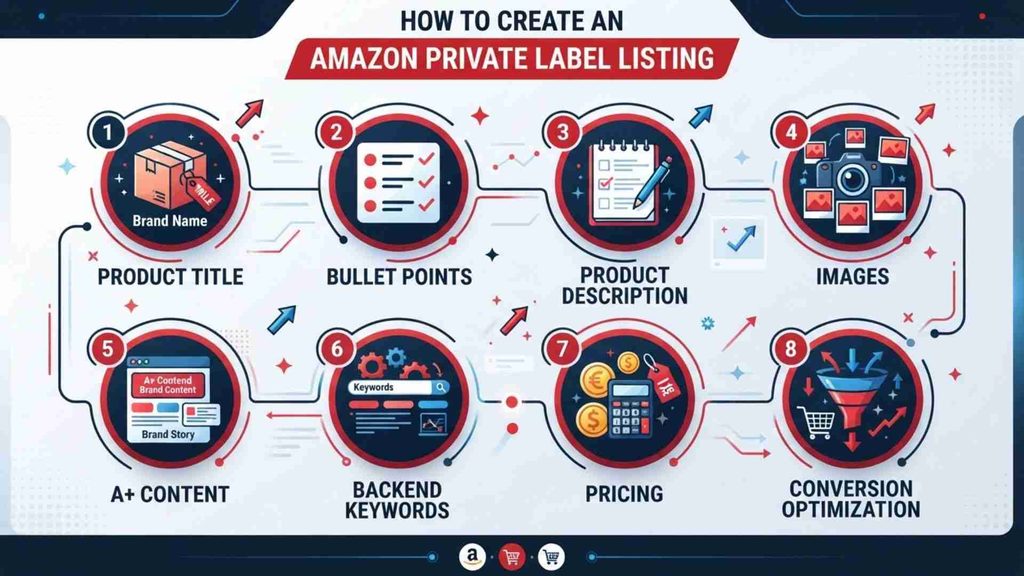
How to Create an Amazon Private Label Listing
Your listing is your storefront. Focus on:
- Product title: clear, keyword-rich, and readable (not stuffed).
- Bullet points: lead with benefits, not just features.
- Product description: expand on use cases and quality details.
- Images: high-quality lifestyle and infographic-style photos, not just a plain product shot.
- A+ Content: available once you’re brand registered, for richer visual storytelling.
- Backend keywords: capture relevant search terms not used in the visible copy.
- Pricing: competitive but aligned with your margin targets.
- Conversion optimization: test and refine based on actual conversion rate data.
Amazon FBA Private Label
Most private label sellers use Fulfillment by Amazon (FBA): you ship inventory to Amazon’s warehouses, and Amazon handles storage, packing, shipping, and returns for each order. This trades a percentage of your margin for Amazon’s fast shipping and customer service infrastructure, often a worthwhile exchange for the sales boost that comes with Prime eligibility.
FBA fees include storage costs and per-unit fulfillment fees, which vary by product size and weight. Some sellers use FBM (Fulfilled by Merchant) instead of shipping orders themselves, usually to preserve margin on slower-moving or oversized items. Many Private label brands use a mix of both depending on the product.
How to Launch an Amazon Private Label Product
A successful launch follows three phases:
Pre-launch
Finalize your listing, confirm inventory is in stock, set launch pricing, complete keyword research, and prepare creative assets like images and A+ content.
Launch
Drive traffic through PPC campaigns, monitor conversion rates closely, and collect search-term data to refine targeting.
Post-launch
Optimize the listing based on early performance, adjust PPC bids, refine keyword targeting, adjust pricing if needed, and manage inventory to avoid stockouts during the critical early ranking period.
Amazon PPC Strategy for Private Label
PPC drives the visibility every new listing needs. Start with a mix of automatic and manual campaigns, do thorough keyword research, and set an initial budget you can sustain for several weeks. Add negative keywords early to cut wasted spend, adjust bids based on performance, regularly analyze search-term reports, and scale budget behind keywords that are already converting well.
Typical Launch Timeline
While timelines vary by product complexity and supplier speed, a rough private label launch schedule looks like:
- Weeks 1–2: Product research
- Weeks 3–4: Supplier sourcing
- Week 5: Samples
- Weeks 6–8: Production
- Weeks 9–10: Shipping
- Week 11: Listing and account setup
- Week 12: Launch and PPC
Complex products, international freight delays, or supplier issues can easily extend this to four or five months, so build in buffer time.
Amazon Private Label Tools
You don’t need dozens of tools to run a private label business. A few reliable tools can cover most tasks:
- Amazon Seller Central: Listings, inventory, sales, FBA, and account management.
- Helium 10: Product research, keywords, competitor analysis, listings, and PPC.
- Jungle Scout: Product research, keyword research, and sales estimates.
- SellerSprite: Product, keyword, and competitor research.
- Keepa: Price history and sales-rank trends.
- Amazon FBA Revenue Calculator: Estimate FBA fees and profitability.
- Amazon Brand Analytics: Customer and brand performance insights for eligible brands.
Use these tools to support your research, but always verify demand, competition, supplier costs, and profitability before investing.
Inventory, Cash Flow, and Key Metrics
Managing Inventory and Cash Flow
Running out of stock kills your ranking momentum; overstocking ties up cash and increases storage fees. Manage this by calculating your reorder point based on lead time and sales velocity, keeping safety stock for demand spikes or shipping delays, and reinvesting profit strategically into reorders rather than spending it all upfront. Cash flow not just profit, is often what makes or breaks a growing private label business, since you typically pay suppliers weeks or months before you see sales revenue.
Metrics That Matter
Track these regularly:
- Sales and unit velocity
- Conversion rate
- ACOS (advertising cost of sale) and ROAS (return on ad spend)
- TACOS (total advertising cost of sale, relative to overall revenue)
- Profit margin
- Return rate
- Inventory turnover
- Unit session percentage (a proxy for listing conversion strength)
Ongoing Optimization
Treat your listing, pricing, PPC campaigns, and inventory as living systems regularly revisit each based on performance data, customer feedback, and competitor moves rather than setting them once and forgetting them.
Common Amazon Private Label Mistakes
- Skipping thorough product research
- Launching without proper validation
- Accepting margins that are too thin to be sustainable
- Ordering too much inventory too early
- Choosing an unreliable or unverified supplier
- Copying competitors instead of differentiating
- Weak product differentiation overall
- A poorly optimized listing
- Mismanaged or underfunded PPC campaigns
- Ignoring cash flow until it becomes a crisis
Amazon Private Label Risks (and How to Reduce Them)
Every private label business carries risk but each can be managed:
- Financial risk: mitigate with conservative budgeting and realistic profit projections.
- Inventory risk: reduce with careful demand forecasting and safety stock.
- Supplier risk: lower by thorough vetting and backup supplier relationships.
- Competition risk: manage through genuine differentiation, not just price cuts.
- PPC cost risk: control with disciplined budget caps and regular optimization.
- Product quality risk: reduce with third-party inspections before shipment.
- Compliance risk: avoid by confirming certifications and restrictions before sourcing.
- Brand protection risk: reduce by registering trademarks and enrolling in Brand Registry early.
When Should You NOT Start Amazon Private Label?
Private label isn’t the right move for everyone right now. Consider holding off if:
- Your available capital is genuinely insufficient to survive slow early months.
- The margins in your target category are too thin after fees.
- You can’t identify a real way to differentiate your product.
- Competition in your niche is dominated by entrenched, heavily reviewed brands.
- You haven’t found a supplier you actually trust.
- Compliance or certification requirements for your product are unclear or unmet.
- You expect fast, guaranteed profits — private label is a real business, not a shortcut.
How to Scale an Amazon Private Label Brand
Once your first product is performing consistently, you can look for ways to expand.
Add Complementary Products
Introduce products that serve the same customer.
Create Variations
Consider different sizes, colors, styles, or configurations where appropriate.
Build Bundles
Combine complementary products into a useful offer.
Scale PPC
Increase advertising investment where performance and profitability justify it.
Improve Organic Visibility
Continue optimizing your listing and building strong sales performance around relevant search terms.
Build an Amazon Store
A brand store can give customers a dedicated place to explore your products.
Expand Marketplaces
Once your operation is stable, consider entering additional Amazon marketplaces where your products make sense.
Improve Inventory Systems
As your catalog grows, forecasting and replenishment become increasingly important.
Build a Product Portfolio
The long-term goal is not necessarily to depend on one SKU. A strong brand can develop a portfolio of related products.
Amazon Private Label Example
Here’s a simplified hypothetical example to show how the numbers work:
- Selling price: $24.99
- Product cost: $5.50
- Freight (per unit): $1.20
- Amazon referral + FBA fees: $7.80
- PPC spend (per unit, early stage): $4.00
- Total cost per unit: $18.50
- Profit per unit: $6.49 (about 26% margin)
After a few months of optimization, better keyword targeting, improved conversion rate, and reduced ACOS that same seller might cut PPC spend per unit to $2.50 while maintaining sales velocity, pushing profit per unit up to roughly $7.99, or about 32% margin. This illustrates why ongoing optimization, not just the initial launch, drives long-term profitability.
Frequently Asked Questions
What is Amazon private label?
Amazon private label is a business model where you sell products manufactured by a third-party supplier under your own brand name, giving you full control over branding, pricing, and the customer experience.
Is Amazon private label profitable?
It can be, typically in the 15–25% net margin range, but profitability depends on product research, cost control, and effective differentiation it’s not guaranteed.
How much money do you need to start Amazon private label?
Most sellers start with $2,000–$10,000, covering samples, initial inventory, branding, and early PPC spend, though costs scale with product complexity and order size.
How do I find private label products?
Look for products with steady demand, manageable competition, clear customer pain points, and room for real improvement over what’s currently on the market.
How do I find a private label supplier?
Common sources include manufacturer directories, sourcing agents, and trade shows — always vet suppliers with samples, certifications checks, and references before committing.
Do I need Amazon Brand Registry?
It’s not required to sell private label, but it’s strongly recommended for brand protection, A+ Content, Sponsored Brands access, and Brand Analytics.
Is Amazon FBA good for private label?
Yes, most private label sellers use FBA for Prime eligibility and Amazon-handled fulfillment, though some mix in FBM for larger or slower-moving items.
How long does it take to launch a private label product?
A typical timeline runs about 10–14 weeks from research to launch, though supplier delays and product complexity can extend this further.
Is private label better than wholesale?
Private label offers higher long-term brand value and pricing control, while wholesale offers faster starts with less differentiation the better choice depends on your goals and available capital.
Can beginners start an Amazon private label business?
Yes, with realistic expectations, solid product research, and enough starting capital many successful private label sellers started with no prior e-commerce experience.
Final Thoughts
Amazon private label services offer a path to building something more durable than a quick resale flip — a real brand with long-term value. It takes more research, more upfront capital, and more patience than other Amazon business models, but for sellers willing to put in the work, it remains one of the most reliable ways to build sustainable income on the platform.
Ready to get started? Begin with product research, validate thoroughly before you spend on inventory, and treat your first product as the foundation for a brand not just a one-off listing.