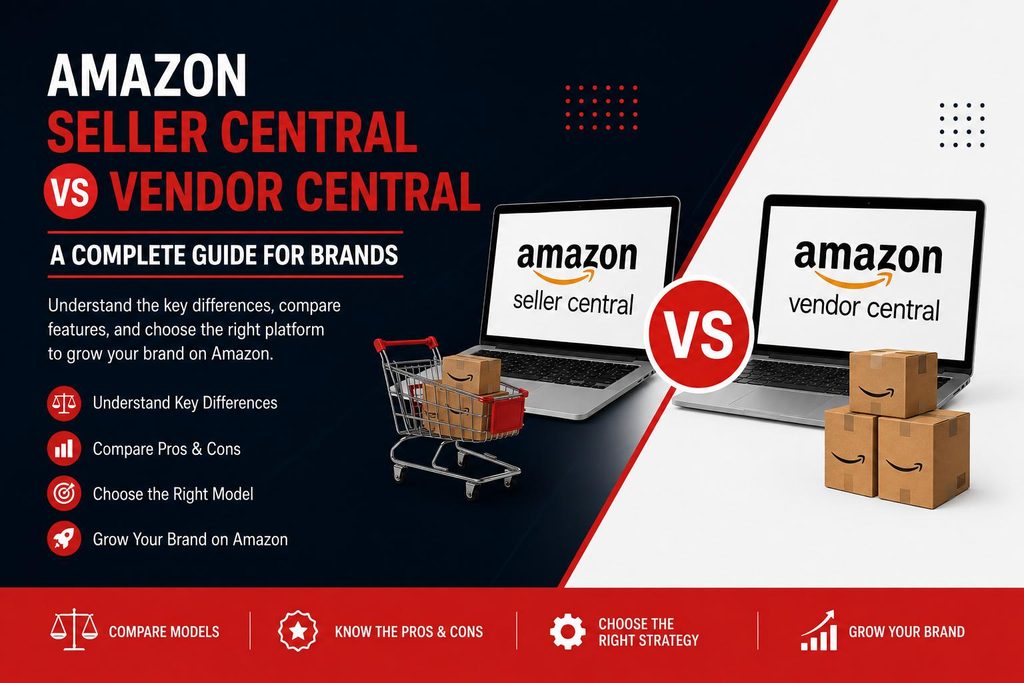
When brands compare Amazon Seller Central and Vendor Central, the first thing they usually consider is profitability. While margins and fees are important, they are not the only factors that should influence the decision. The amount of time, effort, and resources required to manage each platform can also have a major impact on a brand’s overall operations.
Seller Central gives brands more direct control over their Amazon business, while Vendor Central operates through a first-party relationship with Amazon. Because of these differences, the responsibilities involved in managing inventory, pricing, advertising, orders, and account performance can vary considerably.
For this reason, choosing between Seller Central and Vendor Central is not simply a matter of comparing costs. Brands should also consider which model fits their operational capacity, business goals, and long-term growth strategy.
Amazon Seller Central vs Vendor Central: The Quick Answer
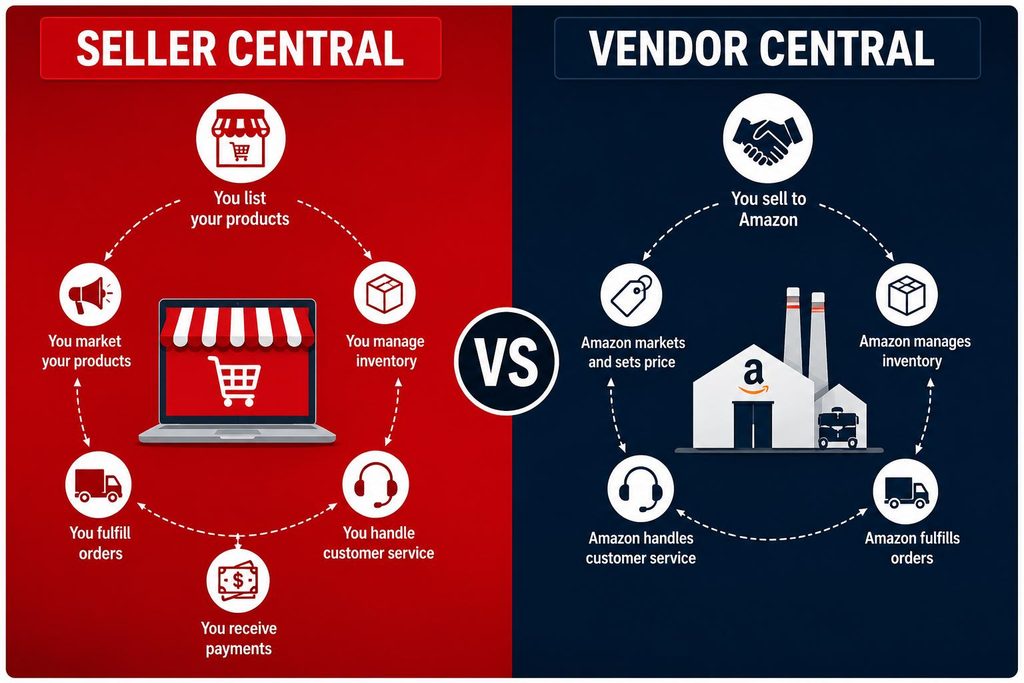
The simplest way to understand the Amazon Seller Central vs Vendor Central difference is to look at who is actually selling to the customer. With Seller Central, your company operates as a third-party seller and sells products directly to shoppers through Amazon. With Vendor Central, your company operates as a first-party supplier: Amazon purchases products from your business and then sells those products to consumers as the retailer. Amazon currently describes Seller Central as the digital hub sellers use to list and price products, manage inventory and fulfillment , analyze performance, advertise, and handle customer-related activities.
That sounds like a straightforward distinction, but it changes almost every part of your Amazon strategy. Seller Central gives brands more control but also more responsibility. Vendor Central can remove some direct retail responsibilities but introduces a wholesale relationship with Amazon that requires strong supply-chain, financial, and vendor-management capabilities. Think of Seller Central as running your own shop inside Amazon’s marketplace, while Vendor Central is closer to supplying one of the world’s biggest retailers. One model puts you closer to the customer; the other puts Amazon between your brand and the customer.
This is why brands should not choose between Seller Central and Vendor Central simply because one appears to offer better margins or less operational work. A platform can look attractive on a spreadsheet and still be a poor fit for your organization if your team lacks the skills required to operate it. Before making a decision, brands should compare pricing control, inventory ownership, fulfillment, advertising, fees, cash flow, operational workload, customer relationships, and long-term growth objectives.
| Decision Factor | Amazon Seller Central | Amazon Vendor Central |
| Business relationship | Third-party seller | First-party wholesale supplier |
| Access | Available to eligible sellers | Invitation-only |
| Who buys from the brand? | Amazon customer | Amazon |
| Retail pricing | Seller controls its offer | Amazon controls retail offer |
| Fulfillment | FBA or FBM | Amazon handles retail fulfillment |
| Customer relationship | Seller is closer to customer | Amazon owns retail relationship |
| Inventory planning | Seller manages marketplace inventory | Brand fulfills Amazon purchase orders |
| Main operational focus | Marketplace management | Wholesale/vendor management |
| Control | Higher | Lower |
| Best suited to | Brands seeking marketplace control | Established brands suited to wholesale |
Amazon confirms that Seller Central is the third-party selling environment, while Vendor Central represents an invitation-only first-party relationship.
What Is Amazon Seller Central?
Amazon Seller Central businesses use to sell products directly to customers through Amazon as third-party sellers. It functions as the operational center for a seller’s Amazon business, covering activities such as product listing, pricing, inventory, fulfillment, order management, reporting, advertising, and account management. Amazon’s current Seller Central documentation describes the platform as a digital hub for sellers to manage and grow their businesses.
Seller Central gives brands multiple fulfillment choices. Amazon currently supports both Fulfillment by Amazon (FBA) and Fulfilled by Merchant (FBM), allowing sellers to choose whether Amazon or the seller handles the physical fulfillment process. This flexibility can be valuable for brands with different product sizes, margins, inventory profiles, or fulfillment requirements.
For a growing brand, Seller Central can therefore be more than a sales account. It can become the operating system for the entire Amazon channel. Your team can monitor sales, manage listings, evaluate advertising performance, plan inventory, adjust pricing, review account health, and build the brand from one environment. The trade-off is equally clear: the more control you receive, the more responsibility your organization must carry.
How Does Amazon Seller Central Work for Brands?
The Seller Central model starts with the brand or business establishing a seller account and creating or matching product listings in Amazon’s catalog. Once products are available, the seller manages the offer, including pricing and inventory, while customers place orders through Amazon. Amazon provides tools to manage orders, returns, inventory, fulfillment, pricing, advertising, and performance from the Seller Central environment.
The important point is that the seller is not simply uploading a product and waiting for Amazon to generate sales. A successful Seller Central operation requires continuous optimization. If a listing has poor images, weak copy, insufficient keyword relevance, or a low conversion rate, someone needs to identify the problem and fix it. If inventory is approaching a stockout, someone needs to react before the listing loses sales momentum. If advertising costs rise while conversion falls, someone needs to investigate the campaigns rather than simply increasing the budget.
Seller Central also provides a wide range of brand-building opportunities. Brands enrolled in Amazon Brand Registry can access tools such as Brand Stores, A+ Content, Amazon Vine, brand analytics, and other brand-protection and marketing features. Amazon states that Brand Registry is available to brands with the required trademark and branding requirements, and brands can use the same credentials for Seller Central or Vendor Central access.
That makes Seller Central particularly attractive to businesses that want to build an Amazon presence rather than simply distribute products through Amazon. Your team can treat the marketplace as a strategic sales channel, test offers, improve conversion, develop branded content, and measure customer behavior. The downside is that all those opportunities create more work. Seller Central rewards active management.
What Does Managing Seller Central Involve?
Managing Seller Central involves much more than order processing. A serious brand operation normally includes catalog management, listing optimization, inventory planning, pricing, advertising, promotions, account health, reporting, customer-related issues, and profitability analysis. Amazon itself highlights listing, pricing, inventory, fulfillment, performance analysis, advertising, promotions, sales reporting, and customer communication among the platform’s core activities.
Inventory management is one of the biggest responsibilities. Even if you use FBA, your business still needs to forecast demand, monitor inventory levels, understand lead times, prepare replenishment shipments, and identify potential stockout risks. A product that is out of stock cannot convert customers, no matter how good its listing or advertising strategy happens to be. Inventory therefore becomes closely connected to SEO, advertising, revenue, and overall account performance.
Listing management is another major workload. Titles, bullet points, images, A+ Content, variations, product attributes, and other listing elements need to accurately represent the product and help customers make purchasing decisions. Amazon also gives brands enrolled in Brand Registry access to enhanced brand-building tools such as A+ Content and Brand Stores.
Then comes advertising. Brands can run Amazon Ads and use campaigns to drive traffic and sales, but effective PPC management requires more than turning campaigns on. Keyword selection, bidding, search-term analysis, campaign structure, budgets, conversion rates, and profitability all require attention. As a result, Seller Central tends to create a broad generalist workload with specialist functions such as PPC, SEO, design, and inventory forecasting layered on top.
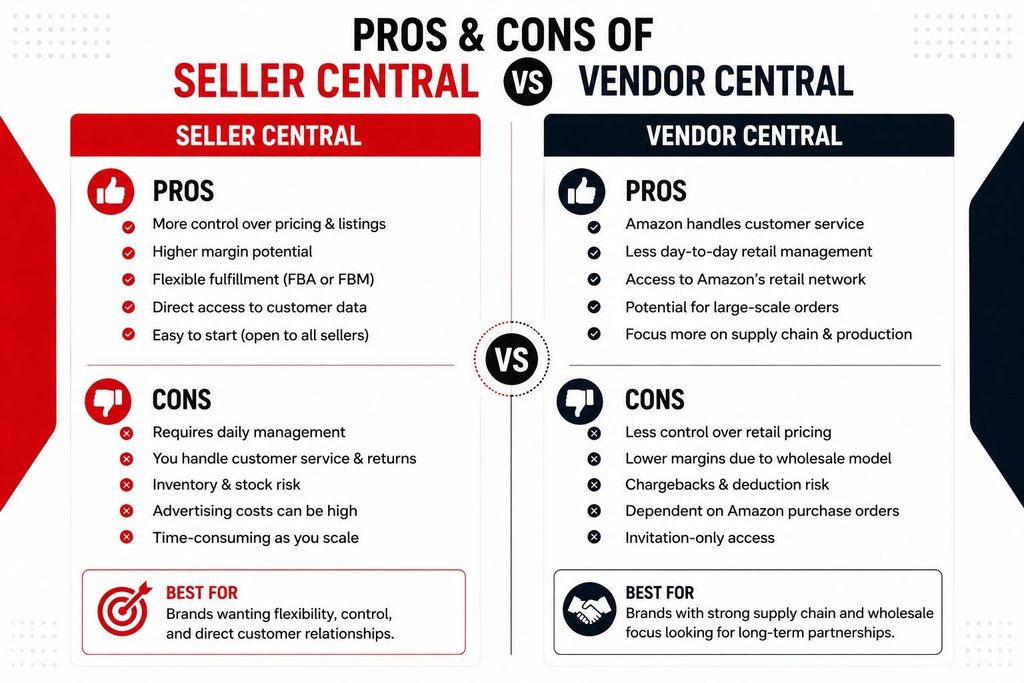
Pros and Cons of Amazon Seller Central
Seller Central’s strongest advantage is control. You can manage your product offers, pricing, inventory, fulfillment method, advertising, promotions, content, and marketplace strategy. Amazon’s current Seller Central resources explicitly provide tools for listing products, setting prices, fulfilling orders through FBA or FBM, analyzing performance, and advertising.
That flexibility makes Seller Central especially attractive to brands that want to move quickly. If a product needs a new image, your team can work on the listing. If a PPC campaign is inefficient, your advertising manager can change it. If inventory needs to be replenished, your operations team can respond. The brand has direct access to many of the levers that influence marketplace performance.
Another advantage is scalability through specialization. A business can begin with one capable Amazon manager and later add PPC, SEO, design, inventory, and account-health specialists as revenue grows. It can also use external agencies where internal hiring is not practical.
Seller Central’s main disadvantage is the amount of responsibility. The platform gives you the keys, but it also gives you the driving. Poor inventory management, neglected PPC, weak content, pricing errors, or unresolved account issues can directly affect sales.
There are also financial considerations. Selling-plan fees, referral fees, fulfillment, advertising, storage, returns, and internal management costs all need to be included in profitability calculations. Amazon’s current Seller Central information confirms that the selling account is accompanied by selling fees and that optional services such as FBA and advertising can add further costs.
What Is Amazon Vendor Central?
Amazon Vendor Central is Amazon’s first-party wholesale model. Instead of selling directly to consumers as a third-party marketplace seller, a vendor sells products wholesale to Amazon, and Amazon then operates as the retailer. Unlike Seller Central, Vendor Central is not simply a second account type that anyone can create whenever they want; Amazon describes Vendor Central as an invitation-only relationship.
This changes the relationship dramatically. Under Seller Central, your company is effectively operating a retail business on Amazon. Under Vendor Central, Amazon becomes your customer from a wholesale perspective. Your business supplies products to Amazon, and Amazon determines how those products are subsequently sold to shoppers.
That can remove some retail responsibilities from your internal team. Amazon handles the consumer-facing transaction and downstream fulfillment, which means the brand does not have to operate the same type of direct marketplace fulfillment model as a Seller Central business. But the work does not disappear. It moves toward purchase orders, supply-chain coordination, wholesale terms, deductions, chargebacks, retail analytics, forecasting, and vendor relationship management.
This distinction is crucial for established manufacturers and brands. If your organization already operates through wholesale distributors and retailers, Vendor Central may feel more familiar than managing every marketplace transaction yourself. If your business is built around direct-to-consumer economics and tight control over pricing and customer experience, however, the Vendor model may introduce compromises you do not want.
How Does Amazon Vendor Central Work for Brands?
The Vendor Central model begins with Amazon acting as the buyer. Amazon purchases inventory from the brand, and the brand supplies that inventory according to the terms and operational requirements of the vendor relationship. Amazon then sells the products to consumers.
From a business perspective, this means the brand is no longer simply asking, “How do we sell more units on Amazon?” It also needs to ask, “How do we manage Amazon as a major wholesale customer?” That is a different question and requires a different operating model.
Purchase orders become especially important. Your team needs to monitor orders, inventory availability, shipping requirements, and fulfillment performance. A manufacturing or supply-chain problem can affect Amazon’s inventory position, which can then affect retail availability and future purchasing decisions.
The financial side also becomes more complex. A vendor needs to understand its wholesale economics rather than simply looking at a retail selling price. Discounts, allowances, deductions, and other commercial terms can influence what the brand actually earns. That means a Vendor Central profitability analysis needs to consider the entire relationship, not simply compare the retail price to manufacturing cost.
Vendor Central also does not mean that advertising and brand growth stop. Brands can still use Amazon’s marketing ecosystem, and Brand Registry is designed to work with brands whether they sell through Seller Central, Vendor Central, or both. Amazon’s current Brand Registry guidance specifically allows brand owners to identify themselves as a seller, vendor, or both during enrollment.
What Does Managing Vendor Central Involve?
Vendor Central management requires a different collection of skills from Seller Central management. The team needs to understand purchase orders, supply-chain planning, wholesale pricing, retail analytics, deductions, chargebacks, inventory availability, forecasting, and Amazon’s vendor processes.
Purchase-order management is central because Amazon’s buying decisions influence the flow of inventory into the retail channel. Your organization needs to coordinate manufacturing, warehousing, transportation, and inventory availability with Amazon’s requirements. Poor execution can create problems that go beyond a single shipment because repeated supply issues can affect the health of the commercial relationship.
Deductions and chargebacks are another area where specialist knowledge matters. A business that does not understand why deductions are occurring, how they should be investigated, and what recovery opportunities exist can allow avoidable costs to accumulate. This is one reason Vendor Central management often requires people with a stronger combination of finance, operations, logistics, and Amazon-specific expertise.
Content and advertising remain relevant as well. Vendor brands still need strong product detail pages, persuasive content, competitive positioning, and effective advertising. The difference is that the brand is accomplishing those goals inside a first-party retail relationship rather than directly operating the retail transaction.
The result is a platform that can feel less hands-on from the consumer side while being highly demanding behind the scenes. Vendor Central is not “less work”; it is different work.
Pros and Cons of Amazon Vendor Central
Amazon current documentation confirmed that vendor central is an invitation only first party relationship in which brands sell products wholesale to Amazon. The biggest advantage of Vendor Central is that Amazon takes the retail role. The brand does not have to operate the consumer transaction in the same way as a Seller Central business. Amazon becomes the wholesale customer and handles the downstream retail relationship.
Another advantage is the potential simplicity of the customer-facing side. The brand does not have to manage every consumer transaction itself because Amazon is the retailer. That can reduce certain day-to-day marketplace responsibilities.Vendor Central also provides access to Amazon’s enormous retail ecosystem. An established brand may be able to use the relationship to expand distribution while relying on Amazon’s retail infrastructure.
But there are important :The biggest is reduced control. Amazon is the retailer, so the brand does not have the same direct control over retail pricing that it has in a third-party selling relationship. This can matter greatly for premium brands, brands with strict channel strategies, and companies concerned about price consistency.
The second disadvantage is specialist complexity. Vendor operations can require expertise in wholesale terms, purchase orders, supply-chain compliance, deductions, chargebacks, forecasting, and financial reconciliation. Those skills may be less common than general e-commerce management skills.
Another disadvantage is that poor operational performance can have commercial consequences. If a brand cannot reliably supply Amazon, the problem can affect the broader relationship. A Seller Central listing issue may be visible and fixable by a marketplace manager; a Vendor Central supply problem can involve multiple departments and commercial stakeholders.
Vendor Central therefore offers a compelling model for the right organization, but it is not automatically the easier model.
Amazon Seller Central vs Vendor Central: Key Differences
The most important Amazon Seller Central vs Vendor Central differences can be understood through control, ownership, pricing, inventory, fulfillment, customer relationships, costs, and operational responsibilities. Seller Central puts the brand in the third-party seller position, while Vendor Central puts Amazon in the role of wholesale customer and retailer. Amazon’s current documentation confirms this fundamental distinction.
Pricing control is one of Seller Central’s strongest advantages. Sellers can enter and adjust their offer prices in Seller Central, and Professional selling accounts have access to Amazon’s Automate Pricing tool for rule-based price adjustments.
Vendor Central works differently because Amazon purchases products wholesale and then operates the retail offer. A vendor therefore needs to be comfortable with less direct control over the consumer-facing price. This can matter enormously for premium brands that want strict control over positioning.
Inventory responsibility also differs. Seller Central gives sellers the ability to use FBA or FBM, allowing them to decide how products reach customers. Amazon’s Seller Central tools support separate management of FBA and FBM inventory.
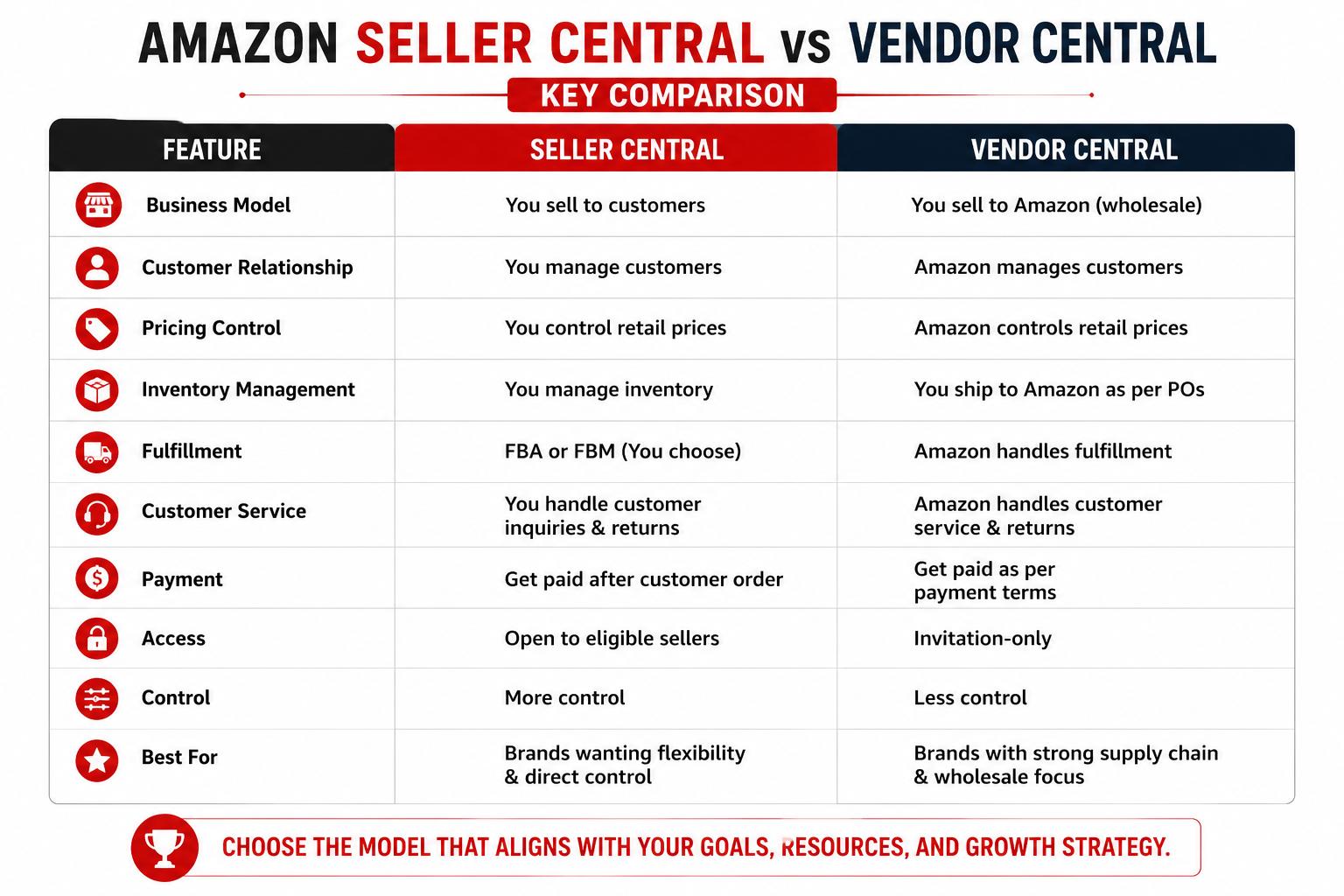
Who Controls Pricing, Inventory, and Fulfillment?
Vendor Central shifts the retail fulfillment process toward Amazon, but the brand still has a major supply-chain responsibility: making sure Amazon can receive the inventory it needs. In other words, Seller Central puts more responsibility on the marketplace seller, while Vendor Central puts greater emphasis on wholesale supply reliability.
The distinction is therefore not simply “who stores the product?” The deeper question is “who controls each stage of the commercial journey?” Seller Central gives the brand more direct control over the customer-facing marketplace. Vendor Central gives Amazon greater control over the retail relationship.
How Are Seller Central and Vendor Central Costs Different?
This is where brands often make their biggest comparison mistake. They look at Seller Central’s visible fees and assume Vendor Central must be cheaper because Amazon buys wholesale. Or they see a higher wholesale discount and conclude Vendor Central must be worse. Neither approach gives you the complete picture.
Amazon currently lists two primary Seller Central selling plans in the US: an Individual plan at $0.99 per item sold and a Professional plan at $39.99 per month, with additional referral fees depending on the category. Optional costs can include programs such as FBA and Amazon Ads.
That means Seller Central economics should be calculated using the complete cost structure. A brand should consider product cost, referral fees, fulfillment, storage, advertising, returns, operational labor, software, discounts, promotions, and other applicable expenses.
Vendor Central requires a different calculation. Instead of focusing primarily on marketplace selling fees, brands need to evaluate wholesale revenue against manufacturing costs, commercial terms, allowances, deductions, chargebacks, advertising investment, logistics, and the internal resources required to manage the vendor relationship.
The right question is therefore not “Which platform has lower fees?” The right question is “Which model produces the better net contribution after all costs and operational requirements are included?”
Seller Central vs Vendor Central: Advertising and Brand Growth
Advertising is important under both models, but Seller Central generally gives a brand a more direct connection between marketplace selling activity and advertising decisions. Sellers can access Amazon Ads through the Seller Central environment and create advertising campaigns, promotions, coupons, and deals.
For a brand focused on aggressive marketplace growth, this can be a major advantage. The company can evaluate traffic, conversion, pricing, inventory, advertising spend, and profitability as interconnected pieces of one Amazon operation. If a campaign needs to be adjusted, the team can react directly.
Brand Registry adds another layer. Amazon currently describes Brand Registry as a free program that provides brand protection and growth tools, including enhanced content, brand marketing tools, Brand Stores, analytics, and other programs. Importantly, Amazon’s current Brand Registry information states that brands can be sellers, vendors, or both.
That means choosing Vendor Central does not mean giving up brand building. A Vendor brand can still invest heavily in content, advertising, brand protection, and customer discovery.
The difference is the commercial environment in which those activities happen. Seller Central gives the brand a more direct role in marketplace execution. Vendor Central places those activities inside a first-party relationship where Amazon remains the retailer.
For brands that want to experiment constantly with pricing, promotions, listing strategy, and marketplace advertising, Seller Central may provide a more natural operating environment. For brands that prioritize wholesale scale and have strong retail relationships, Vendor Central can still be an effective growth channel.
Which Platform Requires More Work and Expertise?
There is no useful one-word answer to “Which is harder, Seller Central or Vendor Central?” because the platforms demand different kinds of work. Seller Central tends to create more visible day-to-day marketplace activity, while Vendor Central can require fewer routine retail actions but more specialized wholesale and operational expertise.
A Seller Central manager may need to understand product listings, Amazon SEO, PPC, inventory, account health, promotions, pricing, FBA, customer-related issues, reporting, and profitability. That makes the platform broad. One person may be able to manage a small account, but the complexity can increase rapidly as the catalog, advertising budget, and revenue grow.
Vendor Central requires a different profile. A strong vendor-management operation may need people who understand supply chain, purchase orders, logistics, financial reconciliation, deductions, wholesale terms, retail analytics, and Amazon-specific vendor processes. Finding someone who can confidently manage all those areas can be harder than finding a general marketplace manager.
This creates an interesting staffing trade-off. Seller Central can be more labor-intensive, while Vendor Central can be more expertise-intensive. A brand should therefore calculate not only hours but also the cost and availability of the skills required to perform those hours correctly.
For smaller brands, Seller Central is often attractive because the business can build capability gradually. A founder or e-commerce manager can start with a manageable catalog and add specialists or agency support as revenue grows. For larger manufacturers, Vendor Central can make sense when the organization already has the wholesale infrastructure required to support Amazon as a retail customer.
Which Amazon Platform Is Better for Your Brand?
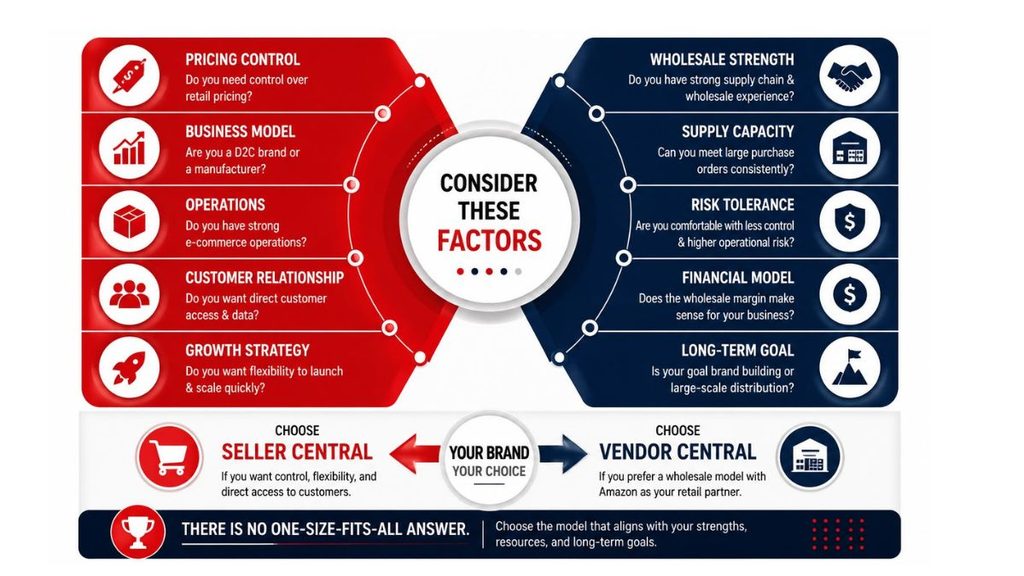
The best platform depends on your business model, not on a universal ranking. If your company wants maximum control over pricing, inventory, marketplace operations, advertising, and customer-facing growth, Seller Central is likely to be the more natural fit.
If your company is an established manufacturer or wholesale-oriented brand and would rather supply Amazon than operate the entire retail relationship, Vendor Central may be more appropriate. But the decision should be based on more than convenience.
Ask yourself what your organization is actually good at. Do you have an e-commerce team that understands Amazon SEO, PPC, listings, FBA, inventory, and marketplace analytics? Seller Central may allow you to turn those capabilities into a competitive advantage.
Or do you already have a sophisticated wholesale operation with forecasting, logistics, finance, and retailer-account management? Vendor Central may fit your existing infrastructure more naturally.
Then look at economics. Build a model that includes all major costs rather than comparing one percentage. Amazon’s official Seller Central pricing information itself makes clear that selling-plan fees are only one component and that additional costs can arise from referral fees, FBA, Ads, and other programs.
Finally, consider control. If losing direct control over retail pricing would create a serious strategic problem for your brand, do not choose Vendor Central simply because Amazon purchases your inventory. If your organization values scale through wholesale and already has the infrastructure to manage Amazon as a major customer, the Vendor model may be worth considering.
Can a Brand Use Both Seller Central and Vendor Central?
Yes. Amazon’s current Brand Registry information explicitly provides for brands that identify as a seller, vendor, or both, meaning brands can operate across both relationships when their circumstances allow it.
A combined strategy can make sense when a brand has different products, channels, or commercial objectives. For example, a business may have certain products that fit a wholesale relationship while maintaining Seller Central control over other products. The exact structure needs to be evaluated carefully because operating both models introduces additional complexity.
The biggest challenge is avoiding channel confusion. Pricing, inventory, product availability, advertising, catalog ownership, and internal reporting all need to be coordinated. Your team needs a clear understanding of which products belong in which model and how the two operations affect one another.
A dual-platform strategy can therefore provide flexibility, but it should not be adopted simply because “more Amazon accounts must mean more sales.” Every additional operational model creates another layer of management.
For brands considering both, the goal should be strategic separation with operational coordination. Decide why each platform exists, what products belong there, how inventory will be allocated, how pricing will be managed, and who owns each responsibility.
Can a Brand Switch From Vendor Central to Seller Central?
A brand can potentially transition from Vendor Central to Seller Central, but the process should be treated as a business migration rather than a simple account change. Before moving, the company should evaluate its catalog,capability, inventory position, advertising strategy, pricing requirements, Brand Registry status, cash-flow needs, and internal Amazon expertise.
The biggest risk is assuming that the transition will happen automatically. Moving from a wholesale relationship to a third-party selling model changes who manages the retail offer and who is responsible for marketplace operations. Your organization may suddenly need to manage activities that Amazon previously handled.
A transition plan should therefore be built around operational readiness. The brand should make sure its Seller Central infrastructure is prepared, product listings are accurate, fulfillment is reliable, advertising is ready, and inventory planning can support the change.
It is also important to protect high-performing products during the transition. Moving every ASIN simultaneously may create unnecessary operational risk. A controlled approach allows the team to test processes, identify problems, and make adjustments before the most commercially important products are affected.
The exact migration process depends on the circumstances of the Amazon relationship and the relevant marketplace. Brands should confirm the current requirements with Amazon before making major commercial changes.
FAQs About Amazon Seller Central vs Vendor Central
What is the main difference between Amazon Seller Central and Vendor Central?
The main difference is the business relationship. Seller Central is a third-party selling platform where the business sells directly to Amazon customers. Vendor Central is a first-party wholesale relationship where Amazon purchases products from the brand and then sells them to customers. Amazon describes Seller Central as the seller’s operating hub and Vendor Central as an invitation-only first-party relationship.
Is Seller Central or Vendor Central more profitable?
Neither platform is automatically more profitable. Seller Central gives brands greater control over retail pricing and marketplace economics but also introduces selling, fulfillment, advertising, and operational costs. Vendor Central operates through wholesale economics, meaning brands need to consider wholesale pricing, commercial terms, deductions, allowances, logistics, and other costs. The correct comparison is the net contribution margin generated by each model, not simply the selling price or one Amazon fee.
Is Amazon Vendor Central invite-only?
Yes. Amazon currently describes Vendor Central as an invitation-only first-party relationship. Seller Central, by contrast, is the platform eligible businesses use to sell directly to customers as third-party sellers. This means a brand generally cannot approach Vendor Central in exactly the same way it can create a standard Seller Central selling account.
Can brands use Amazon Brand Registry with Seller Central and Vendor Central?
Yes. Amazon’s current Brand Registry information supports brands that are sellers, vendors, or both. Brand Registry can provide access to brand-building and protection tools, including enhanced content, Brand Stores, analytics, advertising-related capabilities, and intellectual-property protection. Brands therefore do not need to assume that choosing Vendor Central means abandoning Amazon’s broader brand-building ecosystem.
Which platform is better for a small or growing brand?
For many small and growing brands, Seller Central can be the more practical starting point because it provides direct marketplace access and substantial control over pricing, listings, inventory, advertising, and fulfillment. Amazon’s Seller Central platform also offers FBA and FBM options, allowing businesses to choose how orders are fulfilled. Vendor Central may become more relevant when an established brand has the scale, wholesale infrastructure, supply-chain capability, and commercial relationship needed to operate successfully as an Amazon supplier.
Conclusion: Which Amazon Model Should Brands Choose?
The Amazon Seller Central vs Vendor Central difference is much bigger than the location of a login button or the way Amazon displays a dashboard. These platforms represent two different commercial models. Seller Central puts your business in the third-party seller position, giving you greater control over the marketplace while requiring you to take responsibility for more of the selling operation. Vendor Central puts Amazon in the role of wholesale customer and retailer, reducing some direct retail responsibilities while increasing the importance of wholesale operations, purchase orders, supply chain, and commercial management.
For brands that value control, flexibility, direct marketplace management, and the ability to optimize pricing and advertising, Seller Central can be an excellent fit. Amazon’s current platform provides tools for pricing, inventory, fulfillment, advertising, promotions, reporting, and brand development, giving sellers a broad set of capabilities from one environment.
For brands that have strong manufacturing, wholesale, finance, and supply-chain capabilities, Vendor Central may make more strategic sense. But the attraction should not simply be that Amazon buys your inventory. A vendor relationship needs to be evaluated based on its complete economics, operational requirements, and effect on your brand’s long-term control.
The smartest decision is therefore not to ask, “Which Amazon platform is better?” Ask: “Which Amazon business model can our company operate profitably and consistently at scale?“That answer should come from your numbers, your people, your supply chain, your brand strategy, and your long-term goals.
If your business needs help evaluating or managing its Amazon operation, Ecommerce Apex provides Amazon marketplace services covering Seller Account Management, Vendor Account Management, Amazon PPC, Private Label, Wholesale FBA/FBM, listing optimization, and other e-commerce services. A structured account audit can help identify whether your current Amazon model, staffing, advertising, catalog, and operational setup are aligned with your growth objectives.