If you’re wondering how to start Amazon Wholesale FBM, you’re in the right place. Building a successful Amazon wholesale business starts with choosing the right fulfillment method, and one of the most effective options is Fulfillment by Merchant (FBM). While Fulfillment by Amazon (FBA) often gets the spotlight, many experienced wholesale sellers prefer FBM because it offers greater control over inventory, lower storage costs, and more flexibility.
For new and growing wholesale businesses, Amazon Wholesale FBM can be a practical way to test products, manage cash flow, and avoid some of the fees associated with Amazon’s fulfillment centers. It also gives you direct control over shipping, packaging, inventory management, and customer service—advantages that become even more valuable when handling wholesale inventory.
In this step-by-step guide, you’ll learn how to start Amazon Wholesale FBM, from setting up your seller account and finding reliable wholesale suppliers to managing inventory, fulfilling orders, calculating costs, and scaling your business. Whether you’re an online retailer, a dropshipper transitioning into wholesale, or an entrepreneur looking to diversify your eCommerce business, this guide will give you the knowledge and confidence to launch and grow a successful Amazon Wholesale FBM business.
Ready to grow your Amazon wholesale business? Explore our expert Amazon Wholesale FBM services to simplify supplier sourcing, inventory management, order fulfillment, and long-term business growth.
What Is Amazon Wholesale FBM?
Amazon Wholesale FBM is a business model where sellers purchase branded products in bulk from authorized wholesalers or manufacturers and fulfill customer orders themselves instead of using Amazon’s fulfillment network.
Let’s break it down:
- Amazon Wholesale means buying genuine branded products in bulk at wholesale prices from authorized suppliers.
- FBM (Fulfillment by Merchant) means you store, pack, and ship orders directly to customers after they purchase through Amazon.
Instead of sending inventory to Amazon warehouses, you keep your products in your own storage facility, home warehouse, office, or third-party logistics (3PL) warehouse. When a customer places an order, you prepare the shipment and send it using your preferred shipping carrier.
A Simple Example
Imagine you partner with a distributor that sells branded kitchen appliances.
You purchase:
- 100 coffee makers
- Wholesale cost: $40 each
You list them on Amazon for:
- Selling price: $75 each
When someone orders one:
- Amazon notifies you.
- You pack the coffee maker.
- You print the shipping label.
- You ship it through UPS or FedEx.
- The customer receives the order.
Unlike FBA, your inventory never enters an Amazon fulfillment center.

If you’re new to wholesale, first read our guide on What Is Amazon Wholesale FBA to understand the basics before starting Amazon Wholesale FBM.
How Amazon Wholesale FBM Works
Understanding the complete workflow helps you see why many businesses prefer this fulfillment method.
Step 1: Find Reliable Wholesale Suppliers
Everything begins with sourcing products.
Instead of buying from retail stores, wholesale sellers work with:
- Brand owners
- Authorized distributors
- Manufacturers
- Wholesale marketplaces
- Local distributors
Reliable suppliers provide authentic products, competitive pricing, and consistent inventory—three essentials for long-term success.
Step 2: Purchase Inventory in Bulk
Once approved by the supplier, you place a wholesale order.
Most suppliers have a Minimum Order Quantity (MOQ), meaning you’ll need to purchase a minimum number of units.
For example:
- 50 units
- 100 units
- 500 units
Buying in bulk lowers the cost per unit, giving you healthier profit margins.
Step 3: Store Your Inventory
Unlike FBA, Amazon doesn’t store your products.
Your inventory can be kept in:
- A spare room
- Garage
- Office
- Dedicated warehouse
- Third-party fulfillment center (3PL)
As your business grows, investing in organized shelving, barcode systems, and inventory software can save time and reduce errors.
Step 4: Create Amazon Listings
After receiving your inventory, list the products in Amazon Seller Central. If you’re selling existing branded products, you’ll usually join an existing listing instead of creating a new one.
Your listing should include:
- Competitive pricing
- Accurate inventory levels
- Realistic handling time
- Clear shipping settings
Keeping inventory updated helps prevent overselling and protects your seller metrics.
Step 5: Receive Customer Orders
When a customer purchases your product:
- Amazon processes the payment.
- You receive an order notification.
- Your handling time countdown begins.
Fast order processing is essential. Delayed shipments can negatively impact your seller performance and Buy Box eligibility.
Step 6: Pick, Pack, and Ship
This is where FBM differs significantly from FBA.
You are responsible for:
- Picking the correct item
- Packaging it securely
- Printing shipping labels
- Choosing the carrier
- Uploading tracking information
Many sellers automate this process with shipping software, especially as order volume increases.
Step 7: Handle Customer Service and Returns
With FBM, you manage:
- Shipping inquiries
- Delivery issues
- Return requests
- Refunds
- Customer messages
Providing prompt, professional support helps maintain strong seller metrics and positive reviews.
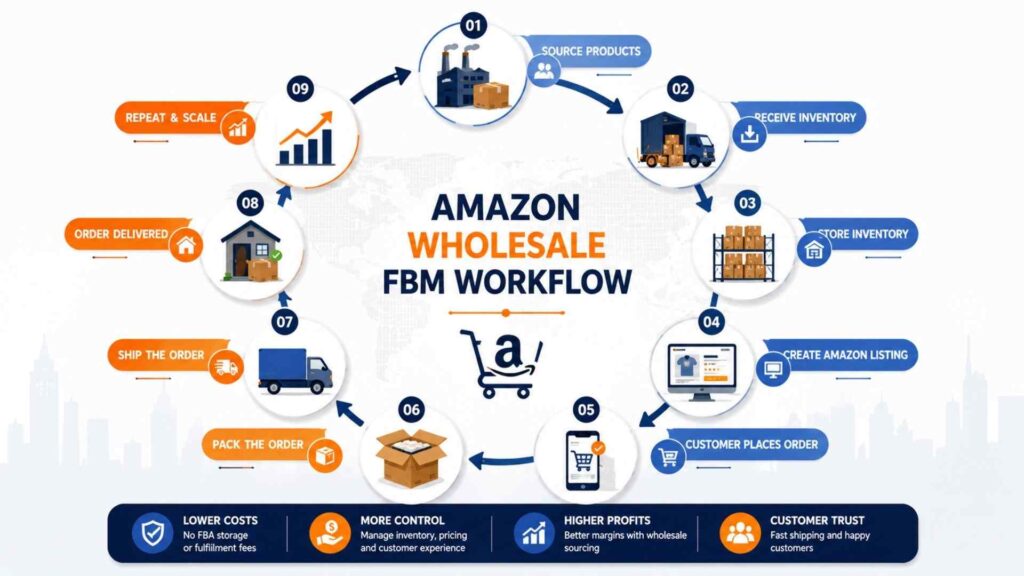
Amazon Wholesale FBM Workflow
Here’s a simplified view of the process:
Wholesale Supplier
        ↓
Purchase Inventory
        ↓
Store Products
        ↓
Create Amazon Listing
        ↓
Customer Places Order
        ↓
Pick Inventory
        ↓
Pack Product
        ↓
Ship Order
        ↓
Customer Receives Package
Each step is under your control, giving you greater flexibility but also more responsibility than FBA.
Amazon Wholesale FBM vs. Amazon FBA
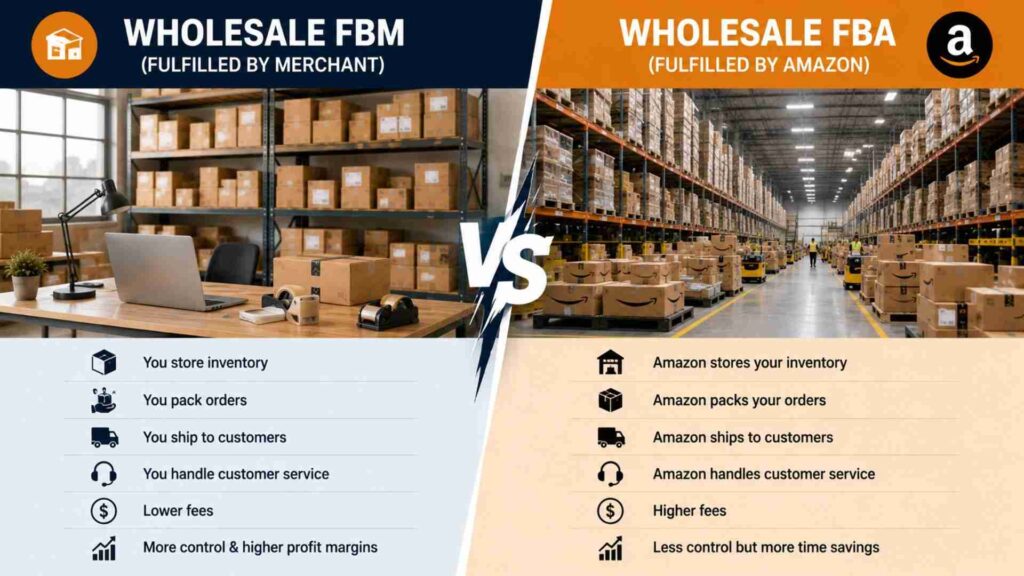
One of the biggest questions new sellers ask is whether they should choose FBM or FBA. The answer depends on your products, budget, and business goals.
| Feature | Amazon Wholesale FBM | Amazon FBA |
|---|---|---|
| Inventory Storage | Your warehouse | Amazon warehouses |
| Shipping | Seller | Amazon |
| Packaging | Seller | Amazon |
| Customer Service | Seller | Amazon |
| Returns | Seller | Amazon (most cases) |
| Inventory Control | Full control | Limited once inventory is sent |
| Storage Fees | Your responsibility | Amazon charges storage fees |
| Startup Cost | Usually lower | Higher due to inbound shipping and FBA fees |
| Flexibility | High | Moderate |
| Best For | Wholesale, oversized items, low-volume products | High-volume, fast-moving products |
When FBM Makes More Sense
FBM is often the better choice if you:
- Already have warehouse space.
- Sell heavy or oversized products.
- Want complete inventory control.
- Sell on multiple marketplaces besides Amazon.
- Prefer avoiding long-term storage fees.
For example, a seller dealing in automotive parts may choose FBM because large items are expensive to store in Amazon’s warehouses.
When FBA Is the Better Option
FBA can be ideal if you:
- Sell lightweight products.
- Have high daily order volume.
- Want Amazon to handle shipping and customer service.
- Prioritize Prime eligibility and faster fulfillment.
Many successful businesses don’t see this as an either-or decision—they use both methods strategically.
What You Should Know About Amazon FBM Before Getting Started
Before learning how to start Amazon Wholesale FBM, it’s important to understand what makes this business model different from other Amazon selling methods. Many beginners assume FBM is simply an alternative shipping option, but successful wholesale sellers know it requires careful planning, reliable supplier relationships, and operational discipline.
Here are the key things every new FBM seller should know.
1. Wholesale Is Different from Private Label
Many people think wholesale and private label are the same, but they follow different business models. With private label, you build your own brand. With Amazon Wholesale FBM, you sell trusted branded products sourced from authorized suppliers, allowing you to focus on inventory and sales instead of brand building.
2. Supplier Relationships Are the Foundation of Success
Your suppliers determine much of your business’s success.
Reliable suppliers offer:
- Authentic products
- Competitive wholesale pricing
- Consistent inventory
- Fast order fulfillment
- Valid invoices for Amazon verification
Building long-term partnerships with reputable distributors can lead to better pricing, priority access to inventory, and improved business stability.
3. Inventory Management Is Your Responsibility
Unlike Amazon FBA, you won’t have Amazon tracking inventory for you.
You’ll need to:
- Monitor stock levels regularly.
- Forecast demand.
- Reorder products before they sell out.
- Prevent overselling.
- Keep accurate inventory records.
Running out of stock too often can hurt your sales momentum, while overstocking ties up valuable cash flow.
4. Winning the Buy Box Requires More Than Low Prices
Many new sellers believe offering the cheapest price guarantees success.
In reality, Amazon considers several factors when awarding the Buy Box, including:
- Competitive pricing
- Fast shipping
- Order Defect Rate (ODR)
- Late Shipment Rate
- Valid tracking rate
- Seller feedback
- Inventory availability
Maintaining excellent seller metrics is just as important as pricing competitively.
5. Shipping Performance Directly Affects Your Account
As an FBM seller, your shipping performance is closely monitored by Amazon.
Late shipments, canceled orders, or poor packaging can lead to:
- Reduced visibility
- Lower Buy Box percentage
- Account warnings
- Selling restrictions in severe cases
Creating efficient fulfillment processes from day one helps protect your account and improve customer satisfaction.
6. Customer Service Matters More Than You Think
Since you’re fulfilling orders yourself, customers will often contact you with questions about shipping, returns, or product issues.
Responding quickly and professionally can:
- Increase positive feedback
- Improve customer trust
- Reduce negative reviews
- Strengthen your seller performance metrics
Excellent customer service is a competitive advantage that many sellers overlook.
7. Amazon Policies Must Always Be Followed
Amazon has strict rules regarding:
- Product authenticity
- Shipping deadlines
- Return handling
- Performance metrics
- Listing accuracy
- Customer communication
Failing to follow these policies can result in listing removals or account suspension. Staying informed and compliant is essential for long-term success.
Who Should Choose Amazon Wholesale FBM?
Amazon Wholesale FBM is a strong choice for:
- New sellers who want more control over inventory
- Businesses with existing warehouse space
- Retailers expanding to Amazon
- Sellers who want to avoid FBA storage fees
- Entrepreneurs building long-term supplier relationships
- Multi-channel sellers managing inventory across platforms
If you’re comfortable handling fulfillment and want greater operational flexibility, FBM can be an excellent business model.
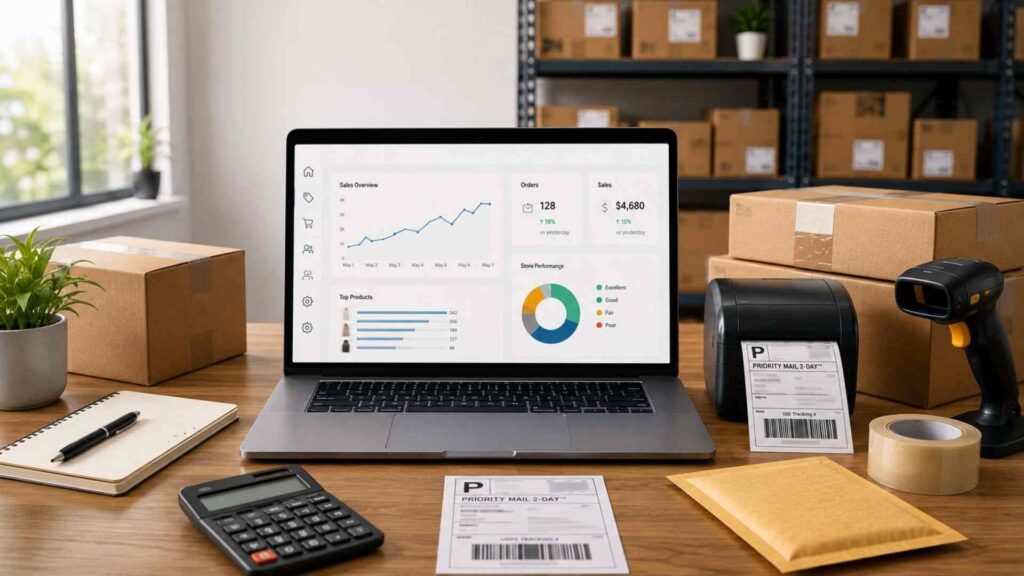
Pros and Cons of Amazon Wholesale FBM
Like every fulfillment model, Amazon Wholesale FBM has advantages and disadvantages. Understanding both sides will help you decide whether it’s the right strategy for your business.
| Pros | Cons |
| Complete inventory control | You manage storage and shipping |
| Lower storage costs | Requires warehouse or storage space |
| Better cash flow | More daily operational work |
| Easier multi-channel selling | Customer service is your responsibility |
| No long-term Amazon storage fees | Shipping delays can hurt seller metrics |
| Greater pricing flexibility | More difficult to scale without systems |
Advantages of Amazon Wholesale FBM
Full Inventory Control
Since your inventory stays in your own warehouse, you can inspect products, move stock between marketplaces, and respond quickly to changes in demand.
Lower Operating Costs
If you already have storage space, FBM can help you avoid monthly and long-term FBA storage fees, especially for oversized or seasonal products.
Multi-Channel Selling
The same inventory can be used to fulfill orders from Amazon, Shopify, Walmart Marketplace, eBay, and your own website.
Better Cash Flow
Instead of paying Amazon to store inventory, you can invest more money into sourcing additional products and expanding your wholesale catalog.
Disadvantages of Amazon Wholesale FBM
More Responsibility
Everything from receiving inventory to shipping orders depends on your processes.
Shipping Performance
Customers expect fast delivery. Delays can negatively impact your seller metrics and customer satisfaction.
Warehouse Management
As inventory grows, you’ll need organized shelving, inventory tracking, and efficient packing systems to avoid fulfillment mistakes.
Verdict
Amazon Wholesale FBM is an excellent option for sellers who want greater control, already have storage space, or sell products that aren’t ideal for FBA. If you’re handling a large volume of daily orders, combining FBM with FBA can provide the best balance between flexibility and automation.
How to Decide Between FBA and FBM
There’s no universal answer. The best fulfillment method depends on your products, available resources, and long-term business strategy.
Choose Amazon FBM If You:
- Already have warehouse or storage space.
- Sell oversized or heavy products.
- Want complete inventory control.
- Sell on multiple marketplaces.
- Want to avoid Amazon’s long-term storage fees.
- Have lower daily order volumes.
Choose Amazon FBA If You:
- Sell lightweight, fast-moving products.
- Receive a high number of daily orders.
- Want Amazon to handle shipping and customer service.
- Want your products to qualify for Prime delivery.
- Prefer a more hands-off fulfillment process.
Choose a Hybrid Model If You:
Many successful sellers don’t choose one model exclusively.
Instead, they:
- Launch new products through FBM.
- Move best-selling products to FBA.
- Keep oversized items under FBM.
- Use FBA during peak seasons.
- Continue using FBM for slower-moving inventory.
This approach helps optimize costs while improving customer experience.
How Much Does It Cost to Sell on Amazon Wholesale FBM?
One of the biggest advantages of Amazon Wholesale FBM is that you avoid Amazon’s storage and fulfillment fees. However, you’ll still have several operating expenses that should be included in your pricing strategy.
Typical FBM Costs
| Expense | Estimated Cost |
| Professional Seller Plan | $39.99/month |
| Amazon Referral Fee | 8%–15% (depends on category) |
| Wholesale Inventory | Varies by supplier |
| Shipping Charges | Depends on product size and destination |
| Packaging Materials | $1–$5 per order |
| Warehouse or Storage | Optional |
| Inventory Management Software | Optional |
| Labor Costs | Optional |
Example Cost Breakdown
Suppose you’re selling a branded coffee machine.
| Item | Cost |
| Selling Price | $120.00 |
| Wholesale Cost | $70.00 |
| Amazon Referral Fee | $18.00 |
| Shipping | $10.00 |
| Packaging | $3.00 |
| Estimated Profit | $19.00 |
This example shows why it’s important to calculate all fulfillment expenses before listing a product.
Why Choose Amazon Wholesale FBM?

Many new sellers assume that Amazon FBA is the only way to build a successful Amazon business. While FBA is a great option for many businesses, it isn’t the perfect fit for everyone. If you want more control over your inventory, lower storage costs, and the flexibility to manage your own fulfillment process, Amazon Wholesale FBM can be an excellent alternative.
Choosing the right fulfillment method is one of the most important decisions you’ll make. Understanding the advantages of FBM will help you determine whether it aligns with your business goals.
1. Lower Startup Costs
One of the biggest reasons sellers choose FBM is its lower upfront investment.
With FBA, you’ll typically pay for:
- Shipping inventory to Amazon fulfillment centers
- FBA fulfillment fees
- Monthly storage fees
- Long-term storage fees
- Inventory removal fees (if necessary)
With FBM, you avoid many of these costs because you store and ship products yourself or through a third-party logistics (3PL) provider. This makes it easier for new wholesalers to get started without investing heavily in Amazon’s fulfillment network.
Example:
Suppose you purchase 300 units of a household product. Instead of paying Amazon to store the inventory for several months, you can keep it in your own warehouse or with a local fulfillment partner, potentially saving hundreds of dollars in storage fees.
2. Greater Inventory Control
Inventory management is critical in wholesale selling. With FBM, your products remain under your control, allowing you to:
- Track inventory in real time
- Prevent unnecessary storage charges
- Inspect products before shipping
- Repackage damaged items if needed
- Allocate inventory across multiple sales channels
This level of control is especially valuable if you sell on platforms like eBay, Walmart Marketplace, Shopify, or your own website alongside Amazon.
3. Better Cash Flow Management
Cash flow is one of the biggest challenges for wholesale businesses. Every dollar tied up in inventory affects your ability to place new orders.
By avoiding certain FBA-related costs, FBM sellers often have greater flexibility in managing their working capital. This allows them to:
- Reinvest profits into faster-moving inventory
- Test new product categories
- Expand supplier relationships
- Scale inventory strategically
4. Sell Oversized or Heavy Products More Profitably
Large and heavy products often incur higher FBA fulfillment fees. In many cases, fulfilling these orders yourself can be significantly more cost-effective.
Examples include:
- Office furniture
- Fitness equipment
- Automotive accessories
- Home improvement products
- Industrial tools
For these categories, FBM may provide better profit margins than FBA.
5. Multi-Channel Selling Made Easier
               🏬 Warehouse
                    │
     ┌──────────────┼──────────────┐
     │              │              │
  🛒 Amazon      🛍️ Shopify      🏪 Walmart
     │              │              │
     └──────────────┼──────────────┘
                    │
                📦 Orders
                    │
               🚚 Customers
Many successful wholesalers don’t rely solely on Amazon. They also sell through:
- Shopify stores
- Walmart Marketplace
- eBay
- Local B2B customers
- Retail stores
Since your inventory remains under your control, fulfilling orders from multiple channels becomes much simpler than dividing stock across different fulfillment centers.
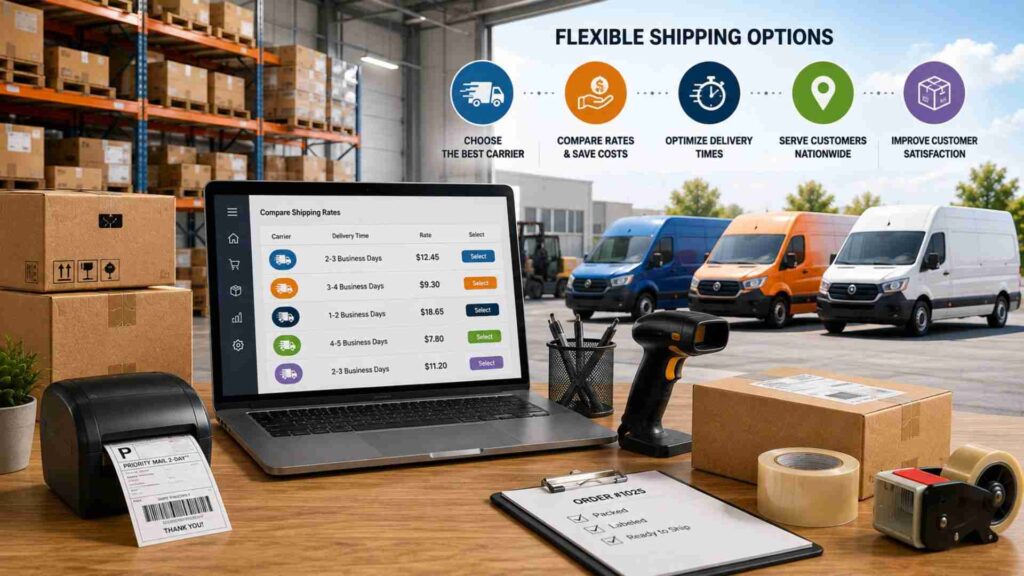
6. Flexible Shipping Options
FBM allows you to choose the shipping carriers and services that best suit your business.
You can compare rates from:
- UPS
- FedEx
- USPS
- DHL
- Regional courier services
This flexibility can reduce shipping costs while allowing you to optimize delivery times based on your customers’ locations.
7. Easier Inventory Testing
Wholesale businesses often test new products before making larger inventory commitments.
With FBM, you can:
- Order smaller quantities
- Monitor sales performance
- Evaluate customer demand
- Scale only the products that perform well
This reduces financial risk and improves inventory planning.
Requirements to Start an Amazon Wholesale FBM Business
Before you buy your first case of product, here’s what you actually need in place — Amazon’s requirements, your suppliers’ requirements, and a couple of things that just save you from a painful surprise later.
1. A Registered Business Entity
Register an LLC (or local equivalent) before reaching out to suppliers. Most legitimate wholesale distributors won’t set up an account for an individual — they expect a registered business. It also separates your personal assets from business liability once you’re carrying real inventory. Budget $50-$500 depending on your state and filing method.
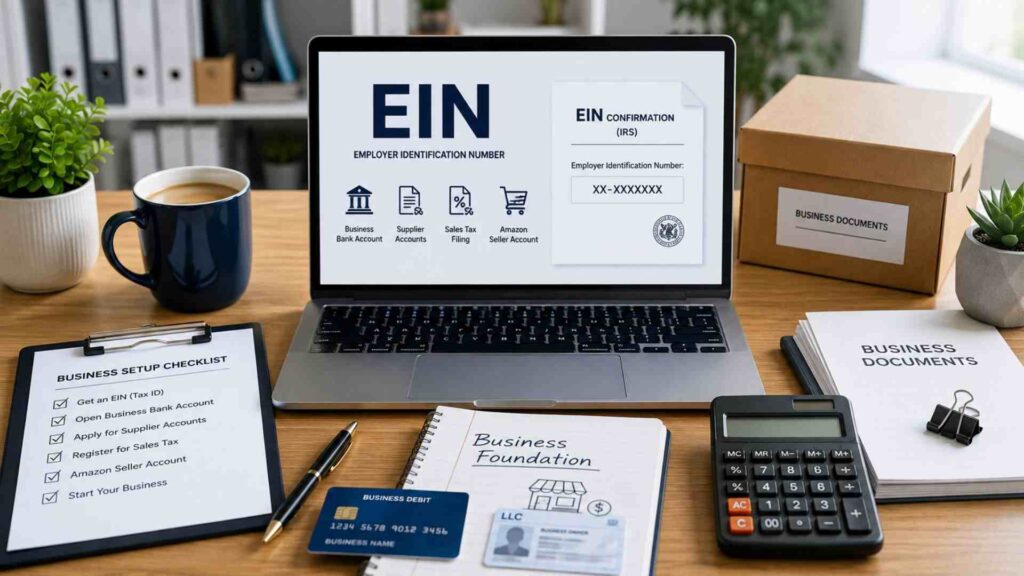
2. An EIN (or Local Tax ID)
You’ll need this to open a business bank account, apply for supplier accounts, file sales tax, and register your Amazon seller account. It’s free through the IRS directly (or your country’s tax authority) — skip paying a third party for it.
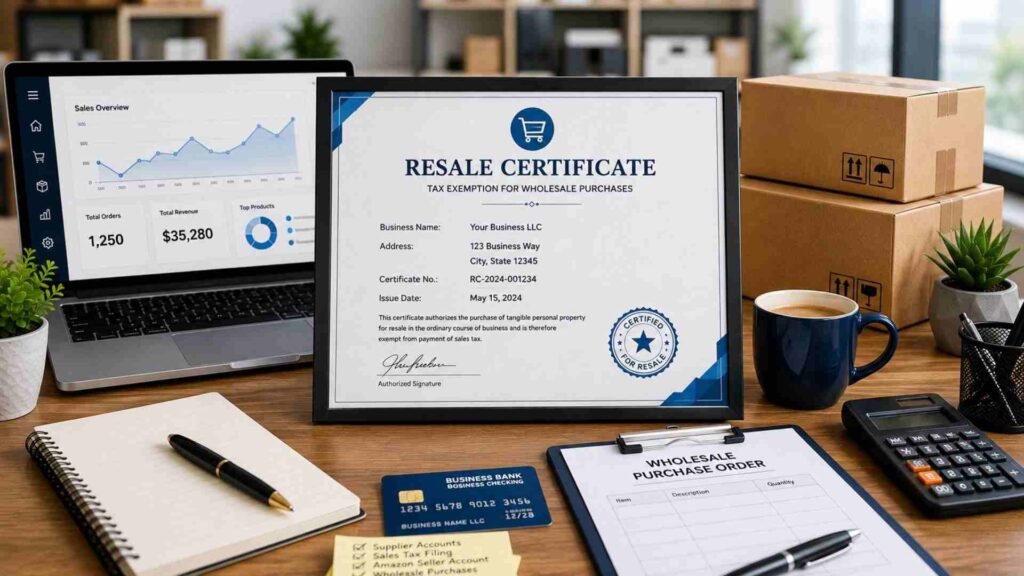
3. A Resale Certificate
This proves to suppliers you’re buying to resell, so they don’t charge you sales tax on wholesale purchases. Skip it and you’ll either overpay on every order or get turned away by suppliers who require it upfront. Apply through your state’s department of revenue.
4. An Amazon Professional Seller Account
The Individual plan won’t work for wholesale. You need Professional ($39.99/month in the US) for bulk listing tools, access to gated categories, and eligibility for ungating requests. Register it under your business information, not personal — it needs to match what suppliers and Amazon’s checks will see.

5. Startup Capital for Inventory
Realistic starting budget: $2,000-$5,000 to stock a few SKUs at meaningful quantities. Watch for MOQs that can run $500-$1,000 per SKU, freight costs to get product to you, and Amazon fees due before you’ve made a sale. Spread your budget across 3-5 products rather than one, so a slow mover doesn’t tie up all your cash.
6. Supplier Relationships
Suppliers will typically want your business license, EIN, and resale certificate before approving an account — expect a real application, not a simple order form. Some approve same-day; others take a week or more. Start supplier outreach early, since it often runs slower than your Amazon setup.

7. Invoices and a System to Store Them
Every order needs an invoice you can retrieve fast if Amazon or a brand challenges your right to sell a product. Set up a simple folder structure (by supplier, then by date) from your very first order.
8. A Fulfillment Plan
For FBM, you need storage space and the ability to pick, pack, and ship reliably. Early on that might be a spare room; as volume grows, you’ll either rent real storage or hand fulfillment to a 3PL. Decide which path you’re on before order volume forces the decision.
9. Category and Brand Approval
Categories like beauty, grocery, and health & personal care are often gated, and some brands are individually gated too. Check gating status before committing to a supplier deal — ungating usually requires your invoice and can take anywhere from a day to a few weeks.
10. Basic Tracking Systems
Even a simple spreadsheet tracking cost, reorder points, and per-SKU profit across suppliers will save you from flying blind. Add a repricing plan for shared listings and a basic process for handling FBM returns and customer questions yourself.
How to Research Products, Find Authorized Wholesale Suppliers, and Get Brand Approval for Amazon FBM
Finding the right products and working with reliable suppliers are two of the most important steps in building a successful Amazon Wholesale FBM business. Before investing your money, take time to research profitable products, verify suppliers, and understand Amazon’s brand approval requirements.
Research Profitable Products
Start by looking for products that have consistent demand, stable pricing, and healthy profit margins. Avoid choosing products based only on high sales volume. Instead, analyze competition, pricing history, and overall profitability to make informed decisions.
You can use tools such as Keepa, Helium 10, Jungle Scout, or SellerAmp SAS to evaluate product performance, estimate monthly sales, and calculate potential profits before making a purchase.
Find Authorized Wholesale Suppliers
Once you’ve identified profitable products, the next step is to source them from authorized wholesale suppliers or distributors. Reliable suppliers provide genuine products, competitive pricing, and Amazon-compliant invoices, which help protect your seller account.
When contacting suppliers, introduce your business professionally and ask about:
- Minimum order quantities (MOQs)
- Wholesale pricing and discounts
- Shipping times
- Return policies
- Amazon selling eligibility
Building strong relationships with trustworthy suppliers can lead to better pricing and long-term business growth.
Get Brand Approval
Some brands and product categories require Amazon’s approval before you can sell them. This process, often called ungating, helps Amazon prevent counterfeit products and maintain customer trust.
To request approval, Amazon may ask for wholesale invoices, supplier information, and business documents. Purchasing inventory from authorized suppliers makes the approval process much smoother and increases your chances of getting approved.
By researching profitable products, partnering with trusted suppliers, and securing the necessary brand approvals, you’ll create a strong foundation for a successful Amazon Wholesale FBM business.
Common FBM Mistakes to Avoid

Avoiding common mistakes can save you time, money, and account-related issues. Here are some of the biggest mistakes new Amazon Wholesale FBM sellers make:
1. Choosing the Wrong Suppliers
Work only with authorized suppliers to avoid counterfeit products and invoice issues that could put your Amazon account at risk.
2. Ignoring Profit Margins
Don’t focus only on sales. Calculate all costs, including Amazon fees, shipping, packaging, and returns, before buying inventory.
3. Shipping Orders Late
Late deliveries can hurt your seller metrics. Process and ship orders on time to maintain customer satisfaction.
4. Poor Inventory Management
Keep track of your inventory to avoid overselling or running out of stock. Inventory management software can help.
5. Selling Restricted Brands
Check whether a brand or category requires Amazon approval before purchasing inventory.
6. Neglecting Customer Service
Respond to customer inquiries quickly and handle returns professionally to maintain positive seller feedback.
7. Competing Only on Price
Instead of always offering the lowest price, focus on fast shipping, reliable service, and maintaining strong seller performance.
8. Ignoring Amazon Policies
Stay updated with Amazon’s policies on product authenticity, shipping, and returns to keep your account in good standing.
Frequently Asked Questions
What is Amazon Wholesale FBM?
Amazon Wholesale FBM is a business model where sellers purchase branded products from authorized wholesale suppliers and fulfill customer orders themselves instead of using Amazon FBA.
2. How do I start Amazon Wholesale FBM?
To start Amazon Wholesale FBM, register a business, create an Amazon Seller Central account, research profitable products, find authorized suppliers, purchase inventory, and list your products on Amazon.
3. How much does it cost to start Amazon Wholesale FBM?
Most beginners can start with $1,000 to $3,000, depending on inventory, business registration, tools, and shipping supplies.
4. Is Amazon Wholesale FBM profitable?
Yes, Amazon Wholesale FBM can be profitable if you source products at competitive prices, manage costs effectively, and maintain strong seller performance.
5. Do I need brand approval to sell wholesale products on Amazon?
Yes, some brands and product categories require Amazon approval (ungating). You’ll usually need invoices from authorized suppliers to get approved.
6. What’s the difference between Amazon FBA and FBM?
With FBA, Amazon stores and ships your products. With FBM, you store inventory and handle packing, shipping, and customer service yourself.
7. Can beginners start Amazon Wholesale FBM?
Absolutely. Beginners can succeed by starting with a small inventory, working with reliable suppliers, and learning Amazon’s policies before scaling their business.
8. How do I find wholesale suppliers for Amazon FBM?
You can find suppliers through authorized distributors, manufacturers, trade shows, wholesale directories, and brand websites. Always verify that the supplier provides authentic products and Amazon-compliant invoices.