Introduction
Starting an online business can feel overwhelming, especially when you’re unsure what to sell, how to find suppliers, or how to compete with established brands. Amazon private label offers a practical way to build your own brand and reach customers through one of the world’s largest e-commerce marketplaces.
But what does it take to turn a product idea into a profitable business?
Learning how to start an Amazon private label business involves more than choosing a popular product and adding your logo. You need to understand customer demand, evaluate competitors, calculate costs, find reliable manufacturers, create a compelling listing, and develop a strategy for attracting sales.
The good news is that you don’t need to manufacture products yourself. Private label sellers typically work with existing manufacturers to produce products that they sell under their own brand, subject to applicable marketplace policies and legal requirements.
In this guide, you’ll discover how to start an Amazon private label business step by step, how much money you may need, which mistakes to avoid, and how to build a foundation for long-term growth.
This Amazon private label guide walks you through the essential steps, from validating your first product idea to launching and growing your brand.
If you want to build and grow your own brand on Amazon, explore our Amazon Private Label Services, including product research, supplier sourcing, branding, listing optimization, and launch strategy.
How Does Amazon Private Label Work? Understanding the Business Model
Before investing money, it’s important to understand the business model and how it differs from other ways of selling on Amazon.
What Is Amazon Private Label?
Amazon private label is a business model in which a seller sources a product from a manufacturer and sells it under their own brand name. The product may be based on an existing design, customized with specific features, or developed to address a particular customer need.
For example, imagine you discover that customers frequently purchase reusable kitchen storage bags. Instead of reselling an established brand, you work with a manufacturer to create your own version with improved seals, clearer size labels, and recyclable packaging.
You then list the product under your brand on Amazon, set your price, manage inventory, and promote it to potential buyers.
Your competitive advantage comes from the product experience, branding, customer service, and marketing rather than simply offering the lowest price.
Understanding how private label works on Amazon can help you decide which product features, branding elements, and pricing strategies will make your offer stand out.
How Is Private Label Different From Other Amazon Business Models?
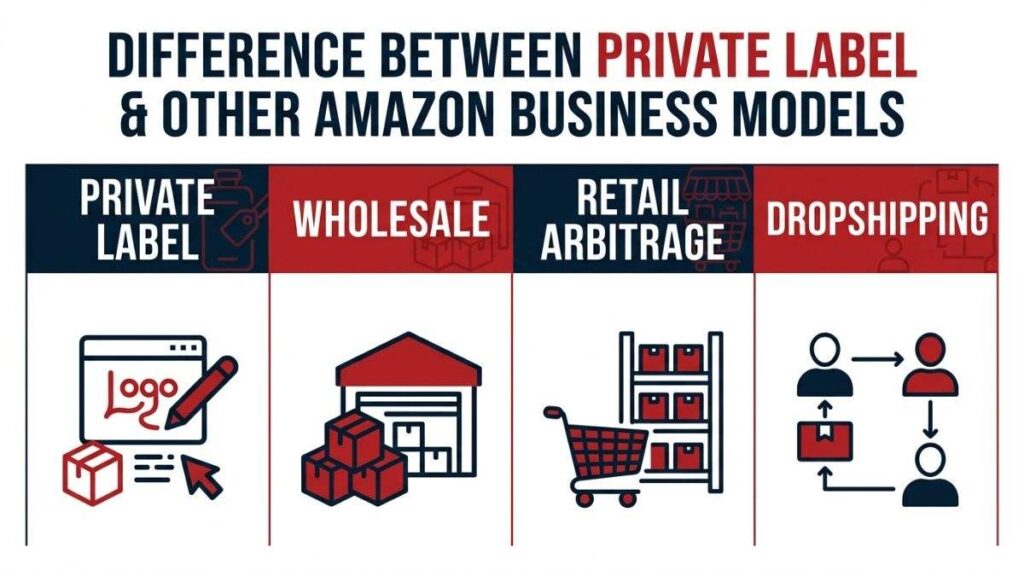
There are several ways to sell products on Amazon.
- Private label: Sell products under your own brand, with greater control over branding and product differentiation.
- Wholesale: Purchase established branded products in bulk and resell them.
- Retail arbitrage: Buy discounted products from retail stores and resell them on Amazon.
- Dropshipping: Arrange for a supplier to ship orders directly to customers, while complying with Amazon’s dropshipping requirements.
Private label can offer stronger opportunities to build brand recognition and customer loyalty. However, it also involves greater upfront investment, product development responsibilities, and inventory risk. Amazon FBA private label vs wholesale depends on whether you want to build your own brand or resell established brands.
Is Amazon Private Label Worth Starting in 2026?
It can be worthwhile if you identify a genuine customer need and manage your finances carefully. However, profitability is not guaranteed.
Competition, advertising costs, marketplace fees, supplier pricing, and changing customer preferences can all affect your results.
The best approach is to start with a focused product, validate demand, and make decisions using real cost estimates instead of relying on claims about easy or guaranteed profits.
Learn how to find profitable Amazon private label products to build a successful Amazon business.
How Does Amazon Private Label Work?
Every private label business moves through the same core stages, even if the timeline and details vary by product:
- Product Research: Identify categories and products with strong demand and manageable competition.
- Validation: Confirm the opportunity is real using sales data, reviews, and demand signals.
- Sourcing: Find and vet manufacturers who can produce the product to spec.
- Branding: Develop your brand name, logo, and packaging design.
- Production: Order samples, then place a full production run.
- Listing Creation: Write optimized titles, bullets, descriptions, and upload images.
- FBA Setup: Ship inventory into Amazon’s fulfillment network.
- Launch: Drive initial sales and reviews to build listing momentum.
- PPC Advertising: Run paid ads to generate visibility and ranking.
- Optimization & Scaling: Refine the listing, pricing, and ad campaigns, then expand the product line.
Why Start an Amazon Private Label Business?
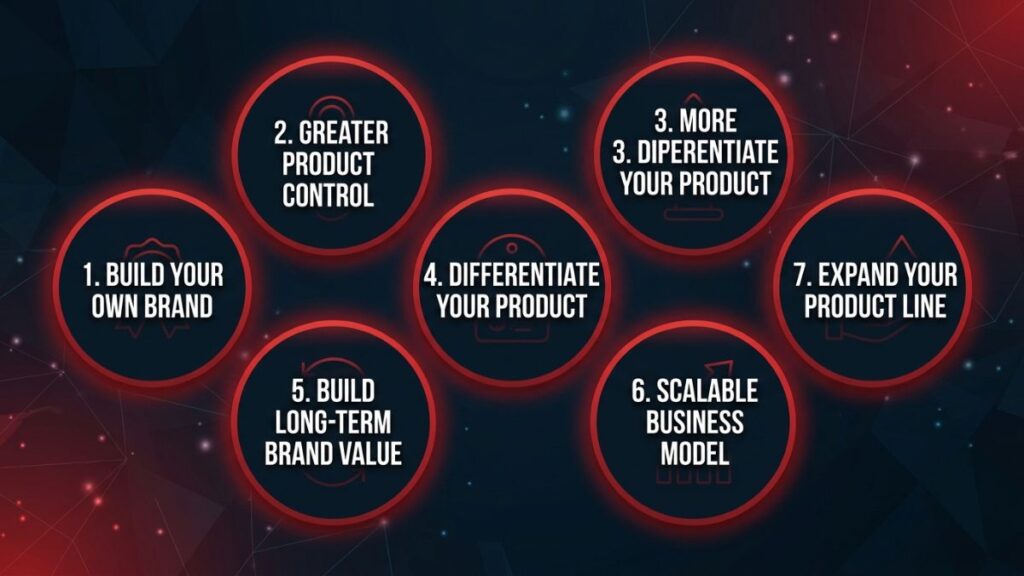
Amazon Private label remains one of the most attractive ways to build a business on Amazon because it gives you greater control over your product, brand, and long-term growth. Instead of reselling someone else’s product, you create an asset that can grow with your business.
Here are some of the key advantages of starting an Amazon private label business:
- Build Your Own Brand: You create and control your own brand rather than selling someone else’s. Over time, your brand can develop recognition, customer trust, and long-term business value.
- Greater Product Control: Private label gives you more control over product quality, materials, features, packaging, and the overall customer experience. You can also improve the product based on customer feedback.
- More Control Over Pricing: Unlike reselling an established brand, you are not competing with multiple sellers offering the exact same product. This gives you more flexibility when setting your pricing strategy.
- Differentiate Your Product: You can identify weaknesses in competing products and create a better solution. Improvements in design, features, packaging, or usability can give customers a reason to choose your product.
- Build Long-Term Brand Value: Every sale, review, returning customer, and product improvement can contribute to your brand’s growth. A successful brand can become a valuable business asset over time.
- Scalable Business Model: Once you find a product that performs well, you can reorder inventory, introduce variations, create bundles, and expand into related products without starting from scratch.
- Expand Your Product Line: As customers become familiar with your brand, launching complementary products can become easier. You can use existing customer insights and brand recognition to expand into new product categories.
Ultimately, Amazon private label is not just about selling a single product. It is about building a recognizable brand that can grow, adapt, and generate value over the long term.
How to Find Profitable Amazon Private Label Products
Good product research is the foundation of a successful private label business. Look for products with:
- Consistent demand: steady search volume rather than a short-lived trend.
- Manageable competition: not dominated by a handful of entrenched, highly-reviewed listings.
- Weak points in competitor reviews: recurring complaints you can fix.
- Clear pain points: the current options on the market don’t solve.
- Room for improvement: in materials, features, or design.
- A healthy selling price:, typically in a range that supports solid margins after fees.
- Real sales potential: evidenced by other sellers’ estimated volume.
- Manageable size and weight: since large or heavy products cost more to ship and store.
- Low seasonality: unless you’re prepared to manage seasonal cash flow.
- No restrictions: avoid gated categories, hazardous materials, or products requiring special certifications you can’t obtain.
Amazon private label product research is the foundation of a successful business. When exploring Amazon private label product ideas, focus on products with strong demand, customer value, and profitable margins.
Evaluate Product Profitability Before Ordering Inventory
A product that sells frequently is not necessarily profitable. Before selling private label products, estimate all sourcing, shipping, Amazon fee, advertising, and return-related costs to understand your potential profit per unit.
Estimate your selling price, manufacturing cost, shipping, import duties where applicable, Amazon fees, advertising expenses, and expected returns.
For example, consider a hypothetical product selling for $29.99:
| Expense | Estimated cost per unit |
|---|---|
| Selling price | $29.99 |
| Product manufacturing | $7.00 |
| Shipping and import costs | $2.00 |
| Amazon referral and fulfillment fees | $7.00 |
| Advertising | $4.00 |
| Other operating costs | $1.50 |
| Estimated contribution profit | $8.49 |
These figures are illustrative, not current fee quotes. Actual fees vary by category, dimensions, weight, fulfillment method, and other factors.
In this example, the estimated contribution profit is $8.49 per unit before any additional expenses not included above, such as initial design costs, certain taxes, or ongoing overhead.
Use Amazon’s current fee schedules and revenue calculator to refine your estimates.
Learn how to calculate your Amazon FBA profit margins to understand your costs and maximize profitability.
Find Reliable Suppliers and Create Your Private Label Product
After selecting a promising product, your next task is finding a supplier that can deliver consistent quality at a sustainable cost.
Where Can You Find Private Label Manufacturers?
Common sourcing options include international manufacturing marketplaces, domestic manufacturers, trade shows, and specialized sourcing agents.
Platforms such as Alibaba can help you discover manufacturers, while domestic suppliers may offer shorter shipping times and easier communication.
Compare several suppliers rather than accepting the first quotation you receive.
Ask about minimum order quantities, production lead times, customization options, packaging requirements, payment terms, and quality-control procedures.
A low unit price is not always the best deal. Poor quality, unexpected shipping expenses, and delayed production can cost more than the initial savings.
Request Samples Before Placing a Bulk Order
Never rely exclusively on product photographs or supplier promises.
Order samples from shortlisted manufacturers and inspect them carefully. Evaluate materials, construction, functionality, packaging, and any safety requirements relevant to your category.
If possible, compare the samples directly with leading competing products.
For products with important performance requirements, create written specifications that define acceptable quality standards. Consider third-party inspections before a large shipment is released.
Negotiate Terms and Protect Your Brand
Before placing an order, confirm the following details in writing:
- Product specifications and permitted substitutions
- Unit price and minimum order quantity
- Packaging and branding requirements
- Production and delivery timelines
- Inspection procedures and defect handling
- Payment schedule and shipping responsibilities
If you’re creating an original design, consider appropriate intellectual property protections and written agreements. Conduct trademark searches before committing to a brand name, and investigate any patents or design rights relevant to your product.
Also confirm that the product meets applicable safety, labeling, testing, and import requirements in your target market.
A dependable supplier relationship can become one of your business’s most valuable assets.
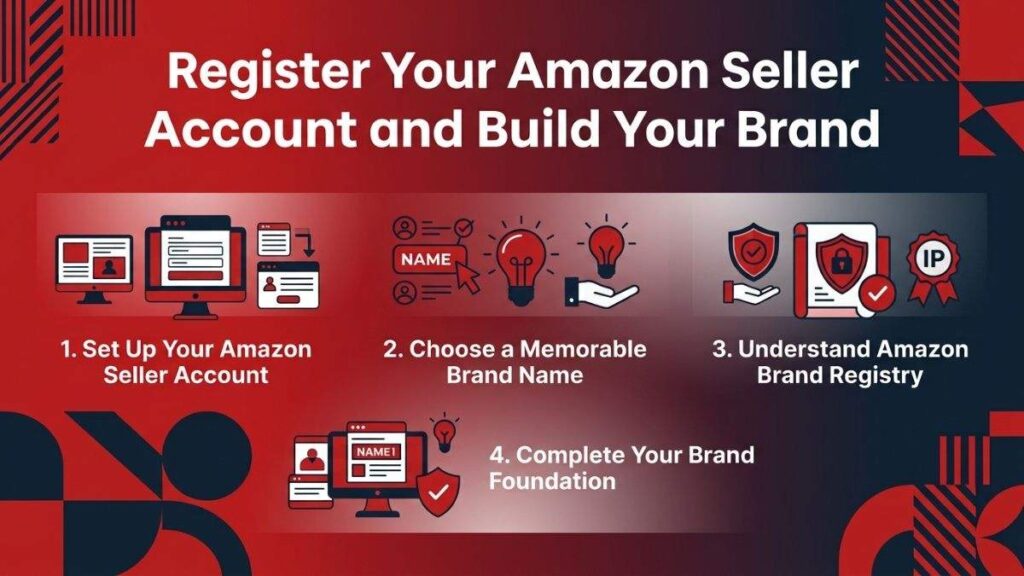
Register Your Amazon Seller Account and Build Your Brand
With a validated product idea and a sourcing plan, you can prepare to sell on Amazon.
Set Up Your Amazon Seller Account
Visit Amazon Seller Central for the marketplace where you intend to operate.
Review the available selling plans, eligibility requirements, identity verification process, payment arrangements, and applicable fees before registering.
Amazon may request documents such as government-issued identification, business registration information, bank details, and tax information, depending on your circumstances and marketplace.
Requirements vary by country, so check the current rules for your intended marketplace.
If you’re operating from outside the United States, including Pakistan, verify seller eligibility, payment options, tax obligations, shipping arrangements, and any documentation needed for your chosen marketplace before investing in inventory.
Do not assume that registering a company in a particular country is always necessary or sufficient. Your legal structure and registration requirements depend on your situation.
Choose a Memorable Brand Name
Your brand name should be easy to remember, relevant to your positioning, and suitable for future expansion.
Before selecting a name, check:
- Trademark availability in relevant markets
- Domain name availability
- Social media handle availability
- Existing Amazon brands and potential conflicts
Avoid names that are confusingly similar to established businesses or that could create intellectual property disputes.
Understand Amazon Brand Registry
Amazon Brand Registry offers eligible brand owners access to tools designed to help manage and protect their brands.
Enrollment requirements can include an eligible trademark and other brand information. Review the current requirements for your marketplace before planning your launch around specific features.
Brand Registry can provide access to certain enhanced brand content and brand-protection tools, subject to eligibility.
You can also investigate whether Amazon’s Brand Analytics and other seller tools are available to your account.
For a step-by-step guide, read our Amazon Seller Account Setup: A Beginner’s Guide.
How to Create an Amazon Private Label Listing
Learning how to sell private label products on Amazon starts with a compelling listing, competitive pricing, clear product images, and relevant keywords. When selling private label products on Amazon, focus on:
- Product title: clear, keyword-rich, and readable (not stuffed).
- Bullet points: lead with benefits, not just features.
- Product description: expand on use cases and quality details.
- Images: high-quality lifestyle and infographic-style photos, not just a plain product shot.
- A+ Content: available once you’re Brand Registered, for richer visual storytelling.
- Backend keywords: capture relevant search terms not used in the visible copy.
- Pricing: competitive but aligned with your margin targets.
- Conversion optimization: test and refine based on actual conversion rate data.
Use Amazon PPC to Boost Product Visibility and Sales
Amazon PPC can help shoppers discover your new product.
A basic structure can include:
Automatic Campaign
Useful for discovering search terms and letting Amazon identify potential traffic.
Manual Campaign
Use targeted keywords based on your research and campaign data.
Product Targeting
Target relevant competing or complementary products where appropriate.
The goal isn’t simply to generate sales.
You want to understand:
Which keywords generate profitable conversions?
Then shift more of your budget toward the strongest opportunities.
Launch Your Product, Manage Inventory, and Grow Sales
Publishing your listing is only the beginning. A successful launch requires careful inventory planning, effective marketing, and ongoing performance analysis.
Choose Between Fulfillment by Amazon and Self-Fulfillment
Amazon offers different fulfillment arrangements, including Fulfillment by Amazon (FBA) and fulfillment by the seller.
With FBA, you send eligible inventory to Amazon’s fulfillment network, and Amazon handles storage, order fulfillment, customer service, and returns according to the program’s terms.
FBA can simplify logistics, but it comes with fulfillment and storage fees. You must also plan replenishment carefully to avoid stockouts or excessive inventory charges.
With seller fulfillment, you manage shipping and other applicable responsibilities yourself or through a third-party logistics provider.
Compare the costs and operational requirements of both options before deciding.
Launch With a Realistic Marketing Plan
Your initial marketing strategy should combine listing optimization with carefully managed promotion.
Depending on eligibility and marketplace rules, your options may include sponsored advertising, coupons, introductory promotions, and other permitted marketing activities.
Start with a defined advertising budget and monitor performance rather than spending aggressively without clear goals.
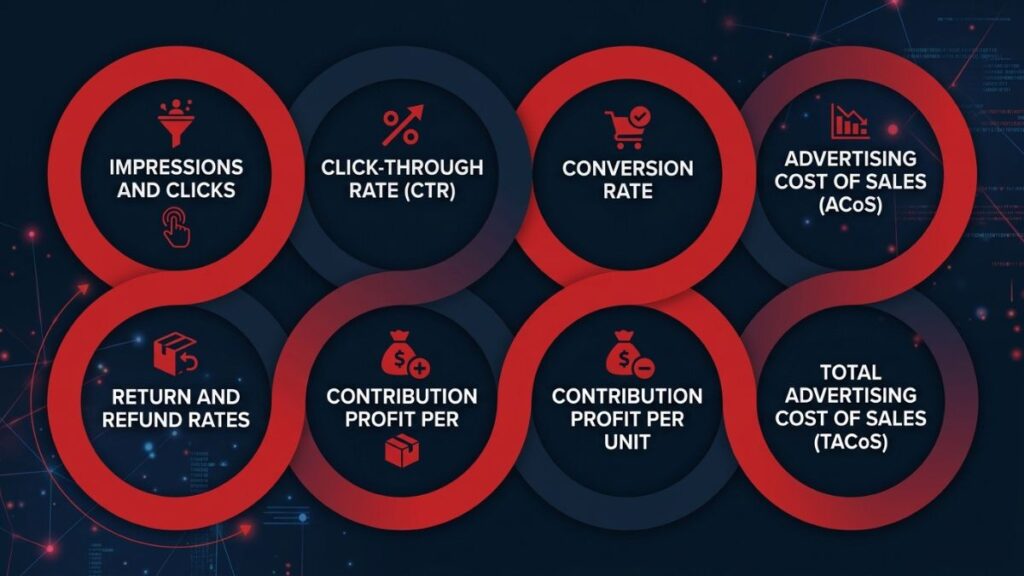
Track metrics such as:
- Impressions and clicks
- Click-through rate
- Conversion rate
- Advertising cost of sales (ACoS)
- Total advertising cost of sales (TACoS)
- Contribution profit per unit
- Return and refund rates
For example, if a campaign generates clicks but few orders, investigate the listing’s price, images, reviews, product-market fit, and delivery experience before simply increasing your budget.
Never purchase fake reviews, manipulate ratings, or offer incentives in exchange for positive feedback. Follow Amazon’s current review and advertising policies.
Monitor Inventory and Improve Performance
Use your sales data to estimate how quickly inventory is moving and when you need to reorder.
Account for manufacturing lead times, international shipping, customs clearance, and possible delays. Keep sufficient working capital available so you can replenish inventory without disrupting the business.
Review customer feedback regularly and look for repeated complaints or requests.
You may discover opportunities to improve packaging, adjust product specifications, update instructions, or introduce a complementary product.
Expansion should be based on evidence of demand and profitability rather than the assumption that adding more products automatically increases revenue.
How Much Does It Cost to Start an Amazon Private Label Business?
Startup costs depend on the product, order quantity, supplier location, marketplace, and launch strategy.
A small test order may require less capital than a large branded launch, but lower initial spending does not eliminate business risk.
The following is an illustrative planning budget for a relatively simple product.
| Expense | Example budget |
|---|---|
| Product samples | $150 |
| Initial inventory | $2,000 |
| Branding and packaging | $300 |
| Freight and import expenses | $600 |
| Photography and listing assets | $250 |
| Initial advertising | $500 |
| Contingency and working capital | $700 |
| Illustrative total | $4,500 |
This is an example, not a minimum investment requirement or a guarantee that $4,500 will be sufficient. Some products cost substantially more, especially those requiring specialized manufacturing, certification, tooling, or larger minimum orders.
Your budget should also account for selling-plan charges, marketplace fees, taxes, insurance where appropriate, and other expenses not separately itemized above.
Can You Start an Amazon Private Label Business With a Small Budget?
Yes, it may be possible to start with a limited budget if you choose a simple product, negotiate a manageable minimum order, and control unnecessary expenses.
However, a small budget limits your ability to absorb mistakes, respond to unexpected costs, or reorder inventory quickly.
Before ordering, calculate your break-even point and estimate how long your available cash must cover expenses before sales generate sufficient funds.
Avoid borrowing money you cannot afford to lose based on optimistic sales forecasts.
The Role of AI in Amazon Private Label
AI is becoming a useful tool for Amazon private label sellers. It can help save time with product research, competitor analysis, keyword research, listing optimization, and customer review analysis.
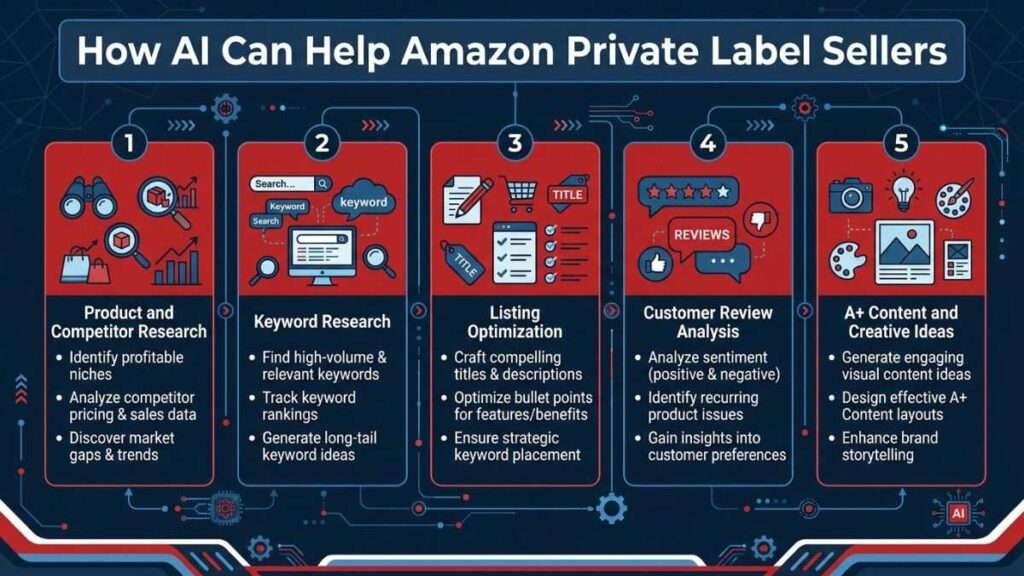
How AI Can Help Amazon Private Label Sellers
Product and Competitor Research
AI can analyze product information, customer feedback, and competitor data to help identify market trends, customer needs, and product opportunities.
Keyword Research
AI tools can help find relevant keywords, long-tail search terms, and search intent that can be used in product titles, bullet points, and descriptions.
Listing Optimization
AI tools demonstrate how private label brands can speed up listing creation by drafting product titles, bullet points, and descriptions that sellers can review for accuracy and relevance.
Customer Review Analysis
AI can quickly analyze customer reviews and identify common complaints, requested features, and positive feedback. These insights can help improve your product.
A+ Content and Creative Ideas
AI can also help generate ideas for A+ Content, product images, comparison charts, and lifestyle visuals to improve your brand presentation.
Use AI as an Assistant, Not a Replacement
AI can save time, but it should not replace human judgment. Always verify product details, Amazon policies, pricing, and compliance information before making decisions.
The best approach is to use AI for research and ideas while relying on real customer demand, product data, and business strategy for final decisions.
Frequently Asked Questions
1. What is an Amazon private label?
Amazon private label is a business model where a seller purchases a product from a manufacturer and sells it under their own brand name on Amazon. The seller controls the branding, packaging, pricing, marketing, and customer experience rather than selling another company’s established brand.
2. How do I start an Amazon private label business as a beginner?
Start by researching product demand and competition. Calculate potential profitability, compare suppliers, order samples, and validate product quality. Then set up an eligible seller account, develop your brand and listing, arrange fulfillment, and launch with a controlled marketing budget.
3. How much money do I need to start an Amazon private label business?
There is no universal minimum. Your costs depend on product complexity, order quantity, shipping, Amazon fees, advertising, and working capital. Build a detailed budget before placing an order and maintain a contingency reserve for unexpected expenses.
4. Is Amazon private label profitable in 2026?
It can be profitable, but results depend on demand, competition, product quality, pricing, fees, advertising efficiency, and inventory management. Research the numbers carefully and avoid treating revenue or estimated margins as guaranteed profit.
5. What are Amazon’s private label brands?
Amazon has launched and sold products under various private-label and exclusive brands across categories such as clothing, household goods, electronics accessories, and everyday essentials. Examples have included brands such as Amazon Basics, Amazon Essentials, and other Amazon-owned or Amazon-exclusive brands. The availability and status of specific brands can change over time.
6. Can you make $10,000 a month selling on Amazon?
Yes, it is possible to generate $10,000 or more in monthly sales on Amazon, but revenue is not the same as profit. Your actual earnings depend on product margins, Amazon fees, advertising costs, shipping, inventory expenses, returns, and other operating costs. Reaching $10,000 in monthly profit generally requires significantly higher sales and careful financial management.
7. Which one is better, FBA or FBM?
FBA and FBM serve different business needs. With Fulfillment by Amazon (FBA), Amazon stores inventory, processes orders, and handles eligible customer service and returns functions. With Fulfilled by Merchant (FBM), the seller manages fulfillment and shipping. FBA can be convenient for sellers who want Amazon to handle logistics, while FBM can provide greater control over fulfillment. The right option depends on your product, margins, sales volume, storage capabilities, and fulfillment costs.
8. How profitable is Amazon private label?
Amazon private label can be profitable, but there is no guaranteed profit margin. Profitability depends on factors such as product demand, sourcing costs, selling price, Amazon fees, advertising expenses, shipping, returns, and competition. Before launching, calculate your estimated profit per unit and account for both fixed and variable costs.
9. What big brands are private label?
Private-label products are common across retail and e-commerce. Major retailers have developed private-label brands in categories such as groceries, clothing, home goods, electronics, and personal care. Examples include Amazon Basics and Amazon Essentials, while retailers such as Walmart, Costco, Target, and other major chains also operate private-label brands.
10. Do I need a trademark to sell private label products on Amazon?
A trademark is not necessarily required for every seller to begin selling a product, but requirements vary by marketplace, product category, and brand-related program. Amazon Brand Registry generally has specific trademark-related eligibility requirements. Review Amazon’s current rules and obtain qualified legal advice when needed.
Conclusion: Start Your Amazon Private Label Business With a Clear Plan
Learning how to start an Amazon private label business is about building a sustainable operation, not finding a shortcut to quick profits.
The process begins with product research and continues through supplier selection, quality control, brand development, listing optimization, advertising, and inventory management.
Each step matters. A product with genuine customer demand, reliable manufacturing, competitive pricing, and a well-optimized listing has a stronger foundation than one selected simply because it appears popular.
You don’t need to launch a large catalog immediately. Start with one carefully researched product, validate your assumptions, and use customer feedback and sales data to guide your next move.
Ready to take the first step? Choose three potential product ideas, research their competition, and estimate their full costs. Compare the results before committing to inventory. A disciplined start can help you reduce avoidable risks and build a more informed path toward long-term growth.